The real story of most cases is not one careless aide. It is the numbers on the staffing sheet and the decisions behind them.
What nursing home neglect really looks like
Most families do not start with the word lawsuit. They start with a feeling that something is wrong: a parent who is suddenly thinner, a wound that will not heal, a fall no one can explain, or a loved one who has grown quiet and pulled away. Nursing home neglect rarely announces itself. It shows up as bedsores that should never have formed, as malnutrition and dehydration in a place that controls every meal, as repeated falls in a resident the staff already knew was at risk, and in the quieter signs of abuse and neglect that families often learn to read too late.
Almost every one of these cases is really about staffing
A nursing home sells a level of care, keeps its beds full, and then runs the floor with fewer hands than that care actually takes. When there are not enough nurses and aides to turn residents, watch fall risks, and get people to the bathroom and the dinner table, the harm that follows is not bad luck. It is the predictable result of a staffing choice made above the bedside. That is why the real story of most cases is the numbers on the staffing sheet and the decisions behind them.
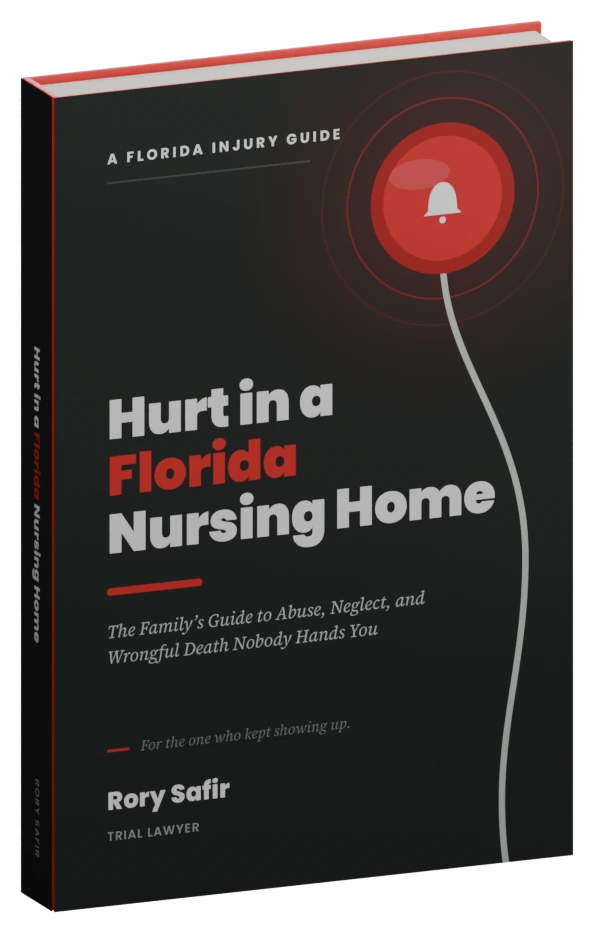
The book
Hurt in a Florida Nursing Home
The warning signs, the records race, the staffing spreadsheet at the root of almost everything, the arbitration trap, and the two-year clock that is shorter than it sounds, in one plain-English book written for the family that suspects something is wrong. Free to Florida families, with the digital edition to read the moment you ask.
I spent time on the other side, so I know how these facilities defend themselves
Before I represented families, I worked on the defense side of these cases, for the facilities and the companies behind them. I know how the defense is built, which records get produced quickly and which ones they hope no one thinks to ask for, how a chart can get tidied up after the fact, and where a confident staffing story falls apart under the facility’s own corporate representative and its own documents. That is the view I now put to work for the families sitting on the other side of it.
How we prove what happened
These cases are won in the paper the facility controls: the medical chart, the medication records, the care plans, the incident reports, and above all the staffing and assignment records that show who was actually working. From there we build the corporate representative deposition and bring in the nurses and physicians who connect a specific deviation to the specific harm. Florida gives residents a statutory bill of rights under section 400.022, and section 400.023 makes a violation of those rights evidence of negligence. The deadline is short, generally two years from when the neglect is discovered under section 400.0236, and the required presuit investigation takes time of its own, so waiting quietly costs you options you cannot get back.
The parts of a nursing home case we handle
If your loved one lived in an assisted living facility rather than a skilled nursing home, the law is different and the case is built differently. Start with our assisted living facility abuse section instead.
Common Questions
How do I know it was neglect and not just my loved one getting older?
Aging explains some decline, but a deep pressure wound, dehydration in a place that controls every glass of water, and unexplained or repeated falls point to care that fell below the standard the law requires. The way to know for certain is to have the records read by someone who reviews them for a living, because the chart usually tells a clearer story than anyone at the facility will.
My parent signed an arbitration agreement when they moved in. Does that end it?
Not necessarily. These agreements are common and facilities lean on them hard, but whether one is enforceable depends on who signed it, what legal authority that person had, and the terms themselves. It is worth having reviewed rather than assumed, because families often give up rights they did not actually surrender.
What does it cost to hire you for a case like this?
These cases are handled on a contingency fee, so there is no fee up front and no fee unless we recover for you, and the first strategy session is free.
How long do I have to file?
Florida generally gives you two years from the date the neglect is discovered or reasonably should have been discovered, with an outer limit of four years, under section 400.0236. Because Florida also requires a presuit investigation that takes time on top of that, the safest step is to have the case looked at quickly rather than waiting.
The facility keeps telling me everything was handled properly. Should I believe them?
Treat it as their position, not the final word. The chart, the staffing records, and the incident reports often tell a different story than the reassurance you get at the front desk, and those records are exactly what an early review pulls before they can be explained away.
This page is general information about Florida nursing home law, not legal advice, and it does not create an attorney-client relationship. The governing authorities include Fla. Stat. 400.022 (residents’ rights), 400.023 (civil enforcement), 400.0236 (two-year limitations and four-year repose), and 768.21 (wrongful death damages). Every case is different, and past results do not guarantee a similar outcome. The hiring of a lawyer is an important decision that should not be based solely on advertisements.