Somewhere behind a door marked Employees Only, a hard drive is probably holding a video of your fall. It shows the hazard, how long it sat there, and the moment you went down. That recording is the most honest witness your case will ever have. It does not misremember, it does not change its story, and it does not work for anybody. And on most commercial systems it is scheduled to be erased, automatically, within days to weeks, unless someone acts to keep it. I call this the evidence race, and in a premises case it starts the day you fall, whether you know you are running in it or not.
Winning that race is premises work I take on directly, and as a member of the National Association of Premises Liability Attorneys I bring a heavy premises trial background to it. I represent injured people, not insurance companies. I am a trial lawyer whose foundation was built in the courtroom as a public defender, where I tried case after case, and the habits from that work, moving fast on perishable proof and reading records line by line, are exactly what the first weeks of a fall case demand. An insurer tends to pay fair value once it sees I will take the case to a jury, and I will. I stay on your case personally, from the first call through trial.
Most falls happen on camera
Start with the good news. Grocery stores, big box retailers, gas stations, restaurants, hotels, and apartment complexes are blanketed in cameras. Installed to catch shoplifters, they run all day, pointed at the aisles, entrances, stairwells, and parking lots. So there is a very good chance a camera saw your fall, what caused it, and everything that happened in that spot for hours beforehand. In a car crash, a camera was usually not watching. In a premises case, one usually was.
The catch is who owns the camera. The footage sits on the owner’s equipment, behind the owner’s locked door, and nothing requires the owner to walk it out to you. Getting it preserved, and then produced, is the work this page is about.
I began my career as an Assistant Public Defender in Tampa, and I am one of a small number of Florida attorneys trained as a forensic lawyer-scientist. Reading physical and scientific evidence is the core of how I have worked for years, and in a fall case that starts with locking down the evidence before it disappears. The preservation letter goes out at the start of my cases, not after the file has aged on a desk. The insurance company is hoping for a lawyer who folds at the first lowball. I read the records line by line, I am not afraid to try a case, and I go the distance for the people I represent. I am a member of the National Association of Premises Liability Attorneys, a national group of attorneys focused on these cases. Learn more about my background.
The loop that erases it
Surveillance systems store a limited amount of footage. When the storage fills, the system records the newest video over the oldest and starts again. On many commercial systems that loop runs somewhere between a week and a month, which means the day of your fall gets swallowed on a schedule measured in days to weeks, not months.
Nobody has to decide to erase the video of your fall. Somebody has to decide to keep it. Left alone, the machine destroys the best evidence in your case as a matter of routine, and the owner can later say, truthfully, that nothing was deleted on purpose, because the system just does that.
And the owner knows the exact date you fell, because an employee wrote it up within the hour, and knows the retention loop to the day. During the weeks when one letter could still freeze the video, no one will call to tell you the clock is running. The reminder has to come from your side, and at the beginning, your side is just you.
What one clip of video proves
In most fall cases the real fight is not whether you fell. It is what the owner knew. Under Fla. Stat. 768.0755, a person who slips on a transitory substance in a business has to prove the business had actual or constructive knowledge of it, and the owner gets to stand up and say nobody knew the danger was there. Video answers that in a way nothing else can, because one piece of footage does three jobs at once: it proves the hazard existed, it proves how long the hazard sat there, and it shows whether anyone actually inspected the area.
Think about that middle job. If the footage shows a cooler dripping onto the tile for two hours while employees walked past it nine times, the owner’s claim that nobody knew collapses on its own timestamps. If the store’s paperwork says someone inspected that aisle at 2:15 and the camera shows an empty aisle at 2:15, the paperwork just became your best exhibit. Pair the footage with a properly measured floor, covered in proving a dangerous floor, and you are no longer telling a story. You are showing one.
And in a negligent security case, video matters doubly. The cameras capture not just the attack itself but the property’s whole security posture: the burned out lights, the broken gate, the empty guard post. In those cases the footage often is the case.
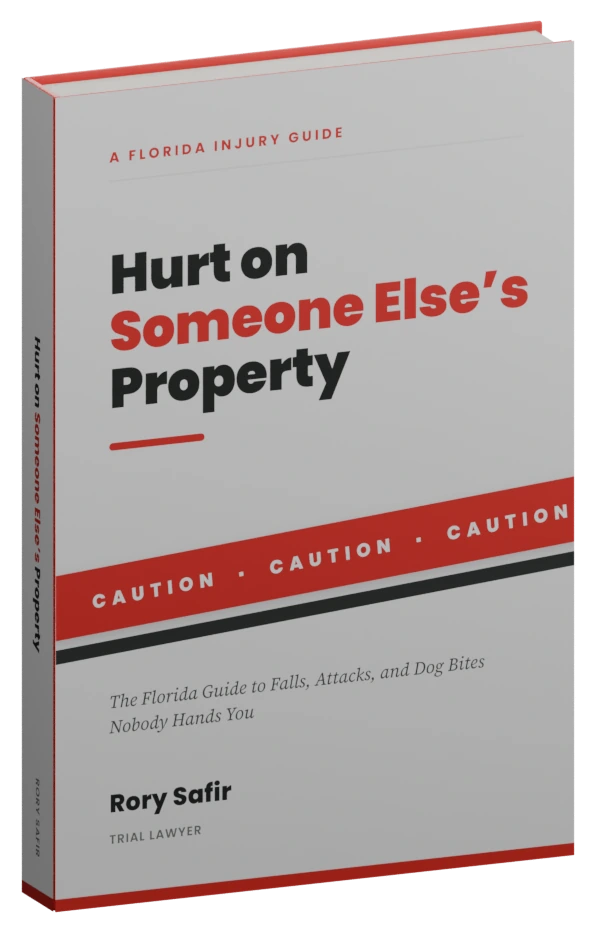
The book
Hurt on Someone Else’s Property
The evidence race, the notice fight, the owner’s records, negligent security, and dog bites, in one plain-English book on the days and weeks after you are hurt on someone else’s property. Free to Tampa Bay residents hurt on someone else’s property, with the digital edition to read the moment you ask.
The incident report that exists but never reaches you
The camera is the headline. Behind it sits a filing cabinet of records that can matter nearly as much, every one of them created by the owner and held by the owner.
There is the incident report, written by the owner’s employee within minutes of your fall. It pins down the date, the location, and the names of everyone who responded, and it sometimes contains candid lines written before anyone was thinking about lawyers. Here is what surprises people: that report is about you, but it is not yours. The owner has no obligation to volunteer it, and asking politely at the customer service counter almost never produces it. Reaching it usually takes a formal demand, and sometimes a lawsuit.
The same is true of the sweep and inspection logs, which either show a real inspection routine or reveal that no one was checking the floor at all. The work orders and repair records can show the owner knew that step was cracked or that cooler leaked long before you came along. And the prior incident reports can show that someone else fell in that same spot before you, which is the kind of fact that changes a case completely. None of it is coming to your mailbox on its own, and your side has to reach it before it gets filed away, misplaced, or aged out of existence.
The hazard that gets fixed overnight
Here is a pattern so reliable you could set a clock by it. The morning after an owner learns someone was hurt, the hazard gets fixed. The broken step gets a fresh tread. The leaking cooler that dripped for a year gets repaired in a day. A bright yellow warning sign blooms on the exact spot where there was never a sign before.
Some of that is genuinely good, because the next person does not get hurt the way you did. But know two things about it. First, the law limits how a later repair can be used against the owner in court. The general idea, and I am stating it softly because the details get technical, is that courts do not want to punish people for making things safer, so the repair itself usually cannot be shown to a jury as proof the owner admits fault.
Second, and this one is your problem: the repair erases the scene. Once the step is fixed, no one can ever again photograph it, measure it, or show it to a jury. The photographs taken on day one become the only version of that hazard your side will ever own.
The preservation letter, in plain English
So how does anyone stop a machine that erases itself and a filing cabinet that only opens from the inside? With a tool that sounds almost too simple to matter: a letter.
A preservation letter is a letter to the property owner that says, in effect: I represent this person, she was hurt on your property on this date, at this time, in this spot, and you are now on notice to preserve the surveillance video from the cameras covering that area, the incident report, the inspection and sweep logs, the maintenance and repair records, and any records of prior incidents there. A good one is precise about the date, the time window, and the camera coverage, so the owner can never claim it could not tell what to keep.
Here is why one page carries so much weight. Before the letter arrives, footage that vanishes into the loop is just routine. A written preservation request puts the owner on notice and creates the duty to preserve, and that duty arises before any lawsuit is filed. After notice, evidence that disappears becomes the owner’s own problem. The law has a name for it, spoliation, and a court can hold the loss against the owner in ways that genuinely hurt, up to and including letting the jury infer that the missing video showed what the owner did not want seen.
The letter flips the clock. Before it, time destroys your evidence. After it, the destruction of evidence starts costing the side that let it happen. One page, sent early enough, changes which side the clock is running against.
You can write to the owner yourself in the first days, in plain words, asking that the video and records from your incident be preserved, and keeping a dated copy. A lawyer’s letter tends to be handled with more care and is written to set up the legal consequences, but the deeper point is timing: the letter only preserves what still exists on the day it arrives. If you want that letter to come from me, the fastest way to start is a free strategy session through my contact page.
What you can preserve yourself, starting today
The letter handles the evidence behind the owner’s door. A second pile of evidence only you control, and it is perishable too.
- Photographs. The hazard, the area around it, the lighting, any warning signs or their absence, and your injuries. If the hazard still exists, photograph it before the overnight fix arrives.
- Your shoes and clothes. Put them in a bag, unwashed, and keep them. The defense will eventually ask what was on your feet, and the actual shoes answer better than memory.
- Names and phone numbers. Witness memory fades fast. A person who saw everything will, within weeks, honestly start to blur the details, and within months may be impossible to find. A name captured on day one is worth more than a subpoena in month six.
- Your own timeline. Write down what happened while it is fresh: where you stepped, what you saw, who said what afterward. Employee comments have a way of evaporating later.
- The report of the fall. Make sure the business knows you were hurt and writes it up, and ask for a copy. You probably will not get one, but the request itself is worth having on record.
The deadline
For a fall on or after March 24, 2023, Florida gives you two years to file suit under Fla. Stat. 95.11(5)(a). Two years sounds like an ocean of time, and for the courthouse part of the case it mostly is. But the legal clock runs in years and the evidence clock runs in days, and the long clock never pauses the short one. A fall case investigated in week one and the same case in month six are, for practical purposes, two different cases. One has footage, logs, and a preserved scene. The other has a letter that arrived after the machine already ate the answer. See the premises liability overview for how the rest of the case fits together.
Common Questions
How do I get store camera footage after a fall?
You almost never get it by asking at the counter. The store owns the footage and has no duty to hand it over on request. The path is to demand in writing, immediately, that the footage be preserved, and then to obtain it through the claim or through discovery once a case is filed. The urgent step is the preservation demand, because most commercial systems record over their footage within days to weeks.
How long do stores keep surveillance video?
It varies by system, but on many commercial setups the recording loop runs somewhere between a week and a month before the system records over itself. The safe assumption is that the window is measured in days, not months, and that nobody will pull the clip aside unless someone puts the business on notice to keep it.
What is a preservation letter, and does it actually do anything?
It is a written demand that the owner preserve specific evidence: the video from identified cameras for an identified time window, the incident report, the inspection logs, the repair records, and prior incident records. A written request puts the owner on notice and creates a duty to preserve that exists before any lawsuit is filed, and evidence that disappears after notice can be treated as spoliation, which courts can hold against the owner, including by letting a jury draw conclusions from the missing video.
Can I send a preservation request myself, before I hire a lawyer?
Yes, and in the first days it is worth doing. Write to the owner in plain words: I was hurt on your property on this date, at this time, in this location, and I ask that you preserve the surveillance video, the incident report, and the inspection and maintenance records. Keep a dated copy. A lawyer’s letter carries more weight, but a preservation request only protects what still exists when it arrives, so speed beats polish.
What if the video was already erased or the hazard already fixed?
The case is not automatically over. Falls were proven before cameras existed, and your own photographs, the incident report, the sweep logs, the repair records, prior incidents, and witness testimony can still carry a claim. And if the erasure happened after the owner was on notice to preserve, the loss itself can become evidence against the owner. Every remaining source also degrades with time, so the right response to lost video is to move faster on everything else, not to give up.
Related: Premises liability overview, Slip and fall, Proving a dangerous floor, Negligent security, and About Rory Safir.
This page is general information about Florida premises liability law, not legal advice, and it does not create an attorney-client relationship. The governing authorities include Fla. Stat. 768.0755 (the notice burden for transitory substances in a business) and 95.11(5)(a) (the two-year limitations period for negligence claims accruing on or after March 24, 2023). Surveillance retention periods are operational practices that vary by business, and the duties and consequences surrounding preservation and spoliation depend on the facts of each case. Every case is different, and past results do not guarantee a similar outcome. The hiring of a lawyer is an important decision that should not be based solely on advertisements.