There is a call I get where the person apologizes before they tell me what happened. They fell at a friend’s cookout, or their mother went down on a dark stair at a neighbor’s house, or their child got hurt in a relative’s backyard, and the first full sentence is some version of “I don’t want to sue anybody, they’re family.” The injury is real, the bills have started arriving, and the person on the phone is ready to swallow all of it rather than point a finger at someone they love. If that is you, hear this first: the guilt rests on a picture of these claims that is mostly wrong. A claim for a real injury at someone’s home is almost never a raid on your friend’s savings. It runs against an insurance policy your friend has been paying premiums on, month after month, for exactly this moment.
Injuries at private homes are premises work I take on directly, and as a member of the National Association of Premises Liability Attorneys I bring a heavy premises trial background to it. I represent injured people, not insurance companies. I am a trial lawyer whose foundation was built in the courtroom as a public defender, and that matters even in a claim that never gets near a courtroom, because an insurer tends to pay fair value once it sees I will take the case to a jury, and I will. I stay on your case personally, from the first call through the end, and I handle the friend-and-family part with the care it deserves.
You are not suing your friend. You are making an insurance claim
Nearly every homeowner in Florida carries a homeowners insurance policy, and inside almost every one of those policies, past the pages about wind and roofs, sits a section called personal liability coverage. That coverage exists for one purpose: it pays when a guest is hurt because of the homeowner’s carelessness and the homeowner is legally responsible for the harm. Your friend has been buying protection for the house all these years, and with the same premiums your friend has been buying protection for this exact situation. Many policies also carry a smaller, quieter feature, often called medical payments coverage, which can pay toward a guest’s medical bills without anyone having to prove the homeowner did anything wrong at all.
When a claim gets made, the insurance company steps in front of your friend. The insurer assigns the adjuster, handles the negotiation, hires and pays the defense lawyer if it ever comes to that, and writes whatever check gets written. In the ordinary case, your friend’s part is to report the claim, hand over the policy information, and tell the truth about what happened. The boundaries are real: policies have limits, some claims get denied and have to be fought, and nobody can promise you any outcome. But the shape of the thing is what I want you to see. Using liability insurance is what liability insurance is for. Your friend bought it on purpose. A claim against it is no more an attack on your friend than a roof claim after a hurricane is an attack on the roof.
I began my career as an Assistant Public Defender in Tampa, and I am one of a small number of Florida attorneys trained as a forensic lawyer-scientist. Reading physical evidence is the core of how I work, and in a home injury case that means the loose step, the dark stairway, and the words spoken in the first hour after the fall. The insurance company is hoping for a claimant with no lawyer at all, because the guilt in these cases keeps so many injured people silent. I read the records line by line, and I go the distance for the people I represent. I am a member of the National Association of Premises Liability Attorneys, a national group of attorneys focused on these cases. Learn more about my background.
What a Florida host owes an invited guest
Most premises law is written for businesses, places that open their doors to the public. A private home runs on the same basic promise, measured to the setting. Florida treats an invited social guest much like a customer in the important way: the host owes reasonable care, which means fixing or warning about dangers the host knew about, or reasonably should have known about, that you would not spot on your own. What reasonable care demands of a homeowner is smaller than what it demands of a supermarket. Nobody expects your friend to walk scheduled inspection sweeps of the back deck the way a grocery store walks its aisles. In practice, these cases nearly always come down to one question: what did the host know, or what should the host have known, and never mention.
Here is what that means in practice. The friend who knows the second step on the back deck has gone soft, and says nothing while you carry a tray down those stairs in the dark, has broken the rule. The friend whose water heater fails without warning while you happen to be standing next to it has almost certainly broken nothing, because that danger announced itself to nobody. And the host who blurts out “we’ve been meaning to fix that step for a year” in the minutes after your fall has just described the whole case, which is why the words spoken in the first hour matter so much.
One clarification, because people sometimes hear an older version of this rule. The thinner duty, where the owner only has to warn about dangers the owner actually knew of, applies to uninvited visitors. If you were invited, for dinner, for a cookout, to watch the game, you are owed the fuller duty of reasonable care. Being family does not lower it. Being a close friend does not lower it. The invitation is what counts.
The friendship does not have to end here
I will not pretend these situations are emotionally simple. I have sat with people who waited months to call me because they could not stand the thought of “going after” a brother-in-law, and I have watched relief move across their faces when they finally understood where the money actually comes from. So here is how these claims go when they are handled with care.
You tell your friend the truth early: you are hurt, the bills are real, and you are going to make a claim against the homeowners policy, which is what the policy is there for. Your friend reports it to the insurance company, the same way they would report a lightning strike. From then on, the claim is mostly a conversation between your lawyer and their insurer, and nobody ambushes anybody.
In my experience, the thing that actually poisons relationships is silence. The injured person quietly drowns in medical debt, the host wonders why the visits stopped, and resentment grows in the space where a ten-minute honest conversation should have been. I see the same pattern in dog bite cases, which run on exactly the same insurance logic and are the most common way families ever use this coverage. Handled honestly and early, a claim like this does not have to end the friendship, and in my experience most of them do not.
One more branch of the same idea: renters carry a version of this coverage too. A tenant with renters insurance is usually carrying personal liability coverage inside it, so an injury at a rented house or apartment can run against the tenant’s policy, the landlord’s policy, or both, depending on who controlled the condition that caused the harm.
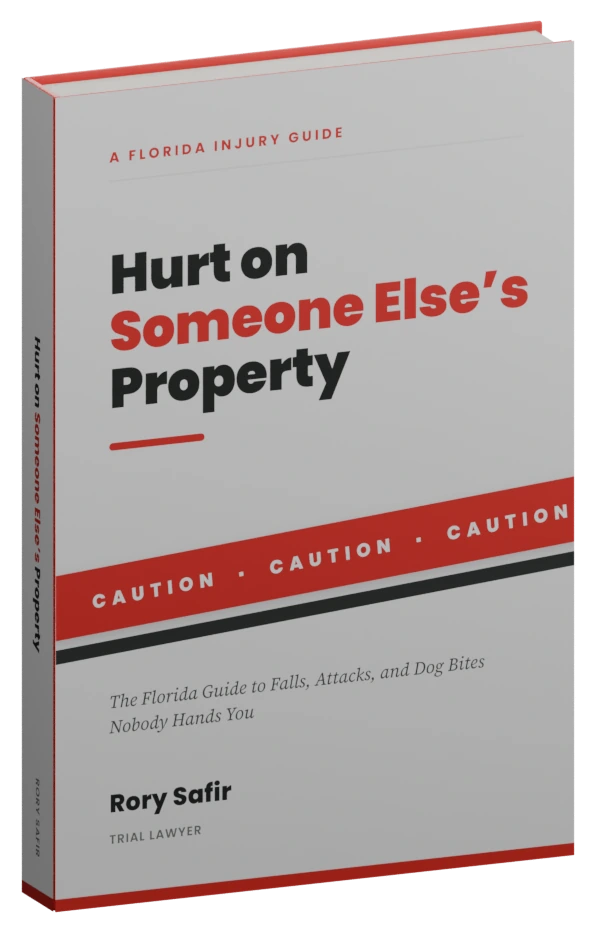
The book
Hurt on Someone Else’s Property
The evidence race, the notice fight, the owner’s records, negligent security, and dog bites, in one plain-English book on the days and weeks after you are hurt on someone else’s property. Free to Tampa Bay residents hurt on someone else’s property, with the digital edition to read the moment you ask.
When the injured person is a child
Children get hurt on other people’s property differently than adults do, and Florida law knows it. Two old ideas do most of the work here.
The first is that a child is held to a child’s standard. In an adult’s case, the defense argues comparative fault, the fight over what share of the blame was yours. With a child, that fight changes shape, because a child is measured against what a reasonable child of similar age, intelligence, and experience would have done, and the very youngest children cannot legally be blamed at all. A defense lawyer can stand up and argue that a forty-year-old should have watched where she was going. That argument has no purchase against a four-year-old, because the law does not pretend a four-year-old was supposed to assess the risk.
The second idea is older than any statute, and it goes by a strange old name, the attractive nuisance. The law has long recognized that certain hazards call to children. A pool, a trampoline, a piece of parked machinery, an open construction site, each pulls at a child’s curiosity in a way an adult never has to think about, and the owner who keeps something like that on the property owes more care because of it. That extra care can reach even a child who wandered in uninvited, because the doctrine exists precisely for the child who cannot understand the danger and could not read a warning if one were posted.
And when a child is hurt at a private home, the money side works the way this page opened: the homeowners policy answers. A family pursuing a claim for a hurt child is not pursuing grandma or the neighbor. The claim runs against coverage that exists for the worst day anyone can imagine, and pursuing it is how the medical bills and the therapy get carried by the insurance built to carry them.
A word about pools
Backyard pools deserve their own page, and they have one. Drowning is a leading cause of death for Florida’s youngest children, which is why Florida law requires residential pools to carry safety features like barriers, self-latching gates, alarms, or approved covers, and why a safeguard that was missing, broken, or switched off becomes powerful evidence of the owner’s negligence. If your child was hurt in or around a pool, anywhere, start with my page on swimming pool and drowning cases, which walks through the safety rules and how those cases get built.
What to do in the first days
The first days matter more than people expect, and none of these steps requires you to be adversarial with anyone.
- Get medical care first and follow through on it. Your health drives everything else, and gaps in treatment are the first thing an adjuster looks for.
- Photograph what hurt you, or ask someone to. The soft step, the loose rail, the dark stairway, the wet tile. Homes get fixed quickly, often out of simple embarrassment, and the condition may not look the same in a month.
- Write down what was said in the first hour. If anyone said the hazard was a known problem, record the words and who spoke them while they are fresh.
- Tell your host the truth early. You are hurt, the bills are real, and the homeowners policy is there for this. Ask them to report it to their carrier.
- Do not give a recorded statement to any insurance company before you get advice. That includes your friend’s carrier. Recorded answers are not required and can be used against you.
- Keep the shoes and clothes you were wearing if you fell, unwashed, in a bag.
If you want to talk any of this through, including the part where you feel terrible about even asking, that is what the first conversation is for. Reach out here and I will give you a straight answer about whether you have a claim worth pursuing.
The deadline
For an injury on or after March 24, 2023, Florida gives you two years to file suit under Fla. Stat. 95.11(5)(a). Two years sounds like a long time, and in a family situation people burn most of it deciding whether to call anyone at all. The evidence does not wait: the step gets repaired and the memory of who said what softens. Starting early does not mean suing anybody. It means preserving the claim while you decide. See the premises liability overview for how the rest of the case fits together.
Common Questions
Do I have to sue my friend to get my medical bills covered?
Almost never. The claim is made against your friend’s homeowners insurance policy, the personal liability coverage their premiums have been buying all along, and the insurer handles it from there. Most of these claims resolve without a lawsuit ever being filed, and even when a suit becomes necessary, the insurance company hires and pays the defense lawyer and pays what gets paid out of the coverage.
Will my friend have to pay anything out of their own pocket?
In the ordinary case, the policy responds and your friend’s role is to report the claim and tell the truth. Policies have limits, and no honest lawyer promises outcomes, but the whole point of personal liability coverage is to stand between the homeowner’s savings and a guest’s genuine injury. Your friend bought that protection on purpose.
What does a homeowner actually owe a guest under Florida law?
An invited guest is owed reasonable care, which means the host must fix or warn about dangers the host knew about, or reasonably should have known about, that the guest would not spot. It is a smaller duty than a business owes its customers, since nobody expects scheduled inspections of a back deck, and these cases nearly always turn on what the host knew or should have known and never mentioned.
My child was hurt at a relative’s house. Is that different?
Yes, in ways that favor the child. A child is measured against a reasonable child of similar age, intelligence, and experience, not against an adult, and the very youngest children cannot legally be blamed at all. Owners also owe extra care wherever something like a pool, a trampoline, or parked machinery foreseeably draws children in, an old doctrine called attractive nuisance. The claim still runs against the homeowners policy.
What if I was hurt at a rented house or apartment?
Renters usually carry personal liability coverage inside a renters insurance policy, so the claim can run against the tenant’s policy, the landlord’s policy, or both, depending on who controlled the condition that caused the harm. Part of the early work in these cases is sorting out who owns, who controls, and whose coverage answers.
Related: Premises liability overview, Swimming pool and drowning, Dog bites, How dog bite claims get paid, and contact the firm.
This page is general information about Florida premises liability law, not legal advice, and it does not create an attorney-client relationship. The governing authorities include Florida’s common law duties owed to invited guests and other visitors, Fla. Stat. 768.81 (comparative negligence), and Fla. Stat. 95.11(5)(a) (the two-year limitations period for negligence claims arising on or after March 24, 2023). Insurance coverage descriptions are general; every policy is different, coverage depends on its terms, and some claims are denied and must be fought. Every case is different, and past results do not guarantee a similar outcome. The hiring of a lawyer is an important decision that should not be based solely on advertisements.