Hillsborough County’s year-round riding weather and dense traffic put a great many motorcyclists on the road, and the county sees hundreds of motorcycle crashes and dozens of rider deaths in a typical year. Because riders are so exposed, those crashes cause some of the most serious injuries on the road. A motorcycle claim also works differently from a car accident under Florida law, in ways that can either help or hurt a rider depending on how the case is handled, and this page explains how these cases work across the county.
Why a motorcycle claim works differently in Florida
Florida is a no-fault state, but that system does not apply to motorcycles, and that single fact changes everything about a rider’s claim. Motorcycles are excluded from Personal Injury Protection, so a rider pays no PIP premium and receives no PIP benefits after a crash, which means there is no automatic coverage waiting to pay the first medical bills. The flip side is a real advantage: because PIP does not apply, the serious-injury threshold that forces car-crash victims to prove a permanent injury before they can recover for pain and suffering does not apply to a motorcyclist either. A rider injured by another driver can pursue the full range of damages, including pain and suffering, from the start. The practical result is that recovery comes from the at-fault driver’s liability insurance, from your own uninsured or underinsured motorist coverage, and from your health insurance, which makes carrying UM and UIM coverage one of the most important things a rider can do. You can read more on our Florida motorcycle accident overview and its guide to insurance and no-fault.
The helmet law and the helmet defense
Florida’s helmet law requires riders and passengers under twenty-one to wear a DOT-approved helmet, and it allows riders twenty-one and older to ride without one if they carry at least ten thousand dollars in medical benefits coverage, though eye protection is required for everyone. When a rider was legally riding without a helmet, the defense will often argue that the choice made a head injury worse and try to shift some blame onto the rider under comparative fault. Florida law does not treat riding without a helmet as automatically negligent, and to make the argument stick the defense has to prove a real causal connection between the missing helmet and the specific injuries. Meeting that argument with evidence, the crash dynamics, the nature of the injuries, and the medical proof, is part of building the case. Our guide to the helmet law and comparative fault and to Florida motorcycle laws goes deeper.
Rider bias, and how these cases are won
Motorcyclists face a bias that car drivers do not. Insurance adjusters, and sometimes jurors, start from an assumption that the rider must have been speeding, weaving, or riding recklessly, and the defense leans into that assumption to push fault onto the rider, because under Florida comparative fault every share of blame it shifts lowers what it pays, and past fifty percent it bars the claim. Overcoming that bias is often the heart of a motorcycle case, and it is won with evidence: the crash reconstruction, the physical evidence, the witness accounts, and a clear account of how the other driver, not the rider, caused the crash. That is courtroom work, the kind of cross-examination and case-building that decides these cases when the insurer will not pay fair value.
Where Hillsborough motorcycle crashes happen
The most common and most dangerous motorcycle crash is the left-turn collision, where a driver turning left across a rider’s path fails to see the motorcycle or misjudges its speed, and these happen at busy intersections across the county. Corridors like Dale Mabry Highway, Bruce B. Downs Boulevard, Fletcher Avenue, and Nebraska Avenue, with heavy traffic and frequent turns, are recurring sites, and the interstates produce high-speed crashes where a rider has little margin. Drivers changing lanes into a motorcycle in a blind spot, and rear-end crashes at lights, round out the pattern. Knowing how these crashes happen, and being able to reconstruct them, is central to answering the claim that the rider was at fault.
Where your Hillsborough case is heard, and getting care
Hillsborough County sits in Florida’s Thirteenth Judicial Circuit, so a motorcycle crash lawsuit is generally filed in the Hillsborough County civil court in downtown Tampa. Most claims resolve through insurance before a lawsuit is necessary, but the cases that settle for full value are prepared from the start as if they will be tried. Prompt medical care matters just as much, both for your recovery and because it creates the record that ties your injuries to the crash, and it matters even more for a rider, since without PIP there is no automatic coverage and a gap in treatment is the first thing an insurer uses to minimize a claim. The most serious injuries in the county are often treated at Tampa General Hospital, the region’s Level I trauma center.
What a motorcycle accident case can recover
Because riders are so exposed, motorcycle crashes cause some of the most serious injuries on the road, and a Florida claim can seek the full range of losses: past and future medical care, the income and earning capacity lost to the injury, and, without the threshold that limits car cases, full compensation for the pain, the disability, the scarring, and the disruption the crash caused. Where a crash took a life, the surviving family can bring a wrongful death claim. What a case is worth turns on the severity of the harm and the strength of the proof, never on a number promised at the first phone call, and building the case to show the full extent of the harm, and to answer the rider-bias and helmet arguments, is what protects its value.
Comparative fault and what to do after a crash
Because the defense will try to blame the rider, the steps you take after a crash matter to both your health and your claim. Get medical care promptly, even if the adrenaline masks the injury, since a gap in treatment is the first thing an insurer uses to minimize a claim. If you are able, photograph the scene, the vehicles, and the road, and get the names of any witnesses, and preserve your helmet, jacket, gloves, and boots, since the gear can show the force of the impact. Report the crash and request the report. Be careful about giving a recorded statement to the other driver’s insurer or accepting a quick settlement before you know the full extent of your injuries, because these cases are often worth far more than the first offer suggests.
A motorcycle case is often won in the courtroom, by overcoming the bias against riders with reconstruction, physical evidence, and hard cross-examination of the insurer’s experts, and by answering the helmet and comparative-fault arguments head on. That trial and evidence work is exactly what I have built my career on. I represent injured riders, not insurance companies, and I came up in the courtroom as a public defender, trying cases and cross-examining witnesses constantly, so I am ready to take a Hillsborough case to a jury when that is what fair value requires. I handle each case personally, and I know the roads, the courts, and the community here. Learn more about my background.
Common Questions
Do I have a case after a Hillsborough motorcycle accident?
If another driver’s negligence caused the crash and you were injured, likely yes. And because motorcycles are exempt from Florida’s no-fault system, you can pursue the full range of damages, including pain and suffering, without meeting the injury threshold that limits car cases.
Do I need to meet the serious-injury threshold to sue?
No. That threshold applies to crashes covered by PIP, and motorcycles are excluded from PIP. A rider can pursue full compensation, including pain and suffering, for any injury caused by another driver’s negligence.
Can I still recover if I was not wearing a helmet?
Often yes. Riders twenty-one and older may legally ride without a helmet if they carry the required medical coverage, and not wearing one is not automatically negligent. The defense may argue it worsened a head injury, but it has to prove a real causal connection.
How long do I have to file after a Hillsborough motorcycle crash?
For most crash injury claims the deadline is two years from the crash, shortened from four by a 2023 change in the law. An early review protects your options and the evidence.
What will a Hillsborough motorcycle accident case cost me?
These cases are handled on contingency, so you pay no attorney’s fees unless there is a recovery, and case costs are advanced rather than paid up front. The first strategy session is free.
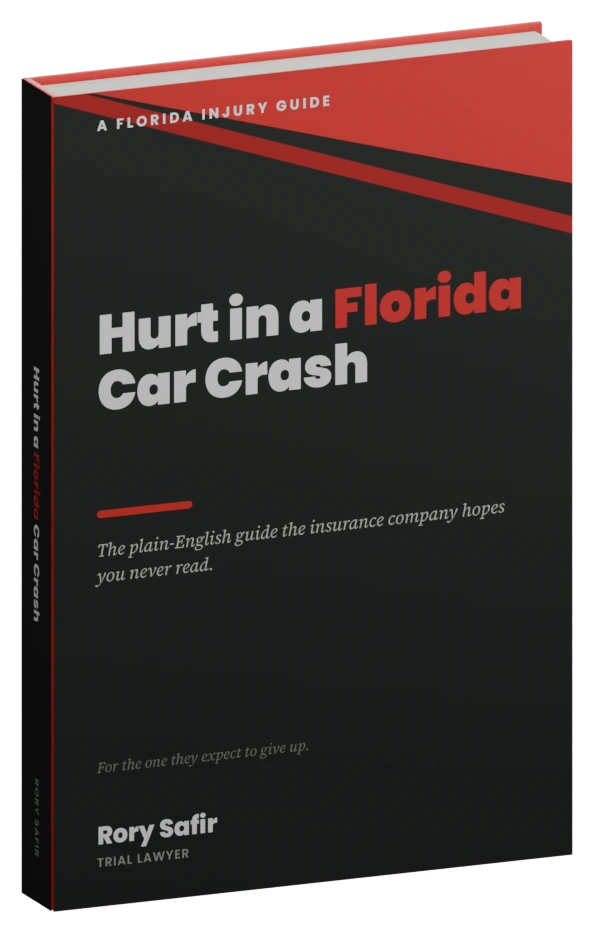
The book
Hurt in a Florida Car Crash
The insurance company’s playbook, the 14-day PIP rule, the serious injury threshold, and Florida’s two-year deadline, in one plain-English book on the hours, days, and weeks after a crash. Free to Tampa Bay crash victims, with the digital edition to read the moment you ask.