If a driver hit you on your motorcycle in Plant City, you can usually hold that driver responsible for your medical bills, lost pay, and pain and suffering, and Florida’s no-fault injury threshold doesn’t stand in your way, because motorcycles sit outside the PIP system. You have two years from the crash to file suit on most negligence claims, and a suit over a Plant City crash is filed in the court’s East Division, which sits in the Plant City Courthouse on North Michigan Avenue. I’m Rory Safir, and I take these cases on contingency, starting with a free strategy session.
Why don’t Florida’s PIP rules apply to motorcycle riders?
Florida’s no-fault law only covers a “motor vehicle,” and section 627.732(3) defines that as a vehicle with four or more wheels, so a motorcycle falls outside it. A rider doesn’t carry PIP for the bike and doesn’t collect PIP benefits after a crash, which means nothing pays the first medical bills automatically. That’s the downside.
The upside is bigger than many folks realize. In a car case, section 627.737(2) bars pain and suffering damages unless the injury is permanent or meets one of the other listed categories. That threshold protects people inside the no-fault system, and a rider isn’t inside it. When a jury found a rider hadn’t met the threshold, Florida’s Fifth District Court of Appeal reversed, and it put the answer in one line: “We hold a motorcyclist is not.” So a Plant City rider hurt by a careless driver can pursue every category of damages, pain and suffering included, without first proving a permanent injury. Our guide to motorcycle insurance and no-fault goes deeper.
| Question | The rule | Where it comes from |
|---|---|---|
| Does PIP cover a motorcycle? | No. Florida’s no-fault law defines a motor vehicle as one with four or more wheels, so a motorcycle isn’t one, and a rider collects no PIP benefits. | Sections 627.732(3) and 627.736(1) |
| Do I have to prove a permanent injury for pain and suffering? | No. The permanent-injury threshold applies to people covered by no-fault, and a Florida appeals court held that a motorcyclist doesn’t have to meet it. | Section 627.737(2); Scherzer v. Beron, 455 So. 2d 441 (Fla. 5th DCA 1984) |
| Is a helmet required? | Yes, unless the rider is over 21 and covered by an insurance policy with at least $10,000 in medical benefits for motorcycle crash injuries. | Section 316.211(1) and (3)(b) |
| Is eye protection required? | Yes, for anyone operating a motorcycle. | Section 316.211(2) |
| What if I was partly at fault? | Your recovery is reduced by your share of fault, and a rider found more than 50 percent at fault for their own harm can’t recover. | Section 768.81(6) |
| How long do I have to sue? | Two years for an action founded on negligence. | Section 95.11(5)(a) |
Read from the 2026 Florida Statutes and the Fifth District’s opinion on November 26, 2026. A helmet law violation is a noncriminal, nonmoving traffic infraction under section 316.211(7).
Who pays my medical bills after a Plant City motorcycle crash?
With no PIP, the money usually comes from three places: the at-fault driver’s bodily injury liability coverage, your own uninsured and underinsured motorist coverage if your policy carries it, and your health insurance or medical payments coverage for the bills that can’t wait. The catch is that Florida’s registration minimums are $10,000 in PIP and $10,000 in property damage liability, according to FLHSMV, so a driver can register a car without any bodily injury coverage. That’s why I look at every policy that might apply, including a policy in the at-fault driver’s household and your own coverage on another vehicle, before anyone talks numbers.
Does Florida require a motorcycle helmet, and does skipping one hurt my claim?
Section 316.211 requires a helmet that meets the federal standard, with one exception: a rider over 21 may ride without one if they’re covered by an insurance policy with at least $10,000 in medical benefits for motorcycle crash injuries. Every operator has to wear approved eye protection, helmet or not.
Riding without a helmet doesn’t erase a claim. The insurer may argue that a helmet would’ve reduced a head injury and try to cut your recovery through comparative fault. A broken leg, a shattered pelvis, or road rash has nothing to do with a helmet. I answer that argument with the crash mechanics and the medical proof. More on that in the helmet law and comparative fault and Florida motorcycle laws.
Where do Plant City motorcycle crashes happen?
Plant City sits about midway between Brandon and Lakeland, and three roads carry most of its through traffic. Interstate 4 runs across the northern part of the city, with exits 17 through 25. U.S. 92 is the main highway through the center of town and runs roughly parallel to I-4, and State Road 39 crosses U.S. 92 downtown, heading north toward Zephyrhills and south toward Hopewell.
The crash I see most often with riders isn’t a high-speed one. It’s a driver turning left across a rider’s lane or pulling out from a side street or parking lot, either never seeing the bike or misjudging how fast it was coming. Those happen at the busy intersections along U.S. 92 and State Road 39 and at the I-4 interchanges, where traffic merges and turns all day. Reconstructing the sight lines and speeds is how the “the rider came out of nowhere” story gets answered. Our page on common motorcycle crash types walks through the patterns.
Which hospital and police agency handle a Plant City crash?
BayCare’s South Florida Baptist Hospital, at 3202 N. Park Rd., is the hospital in Plant City itself. For the worst injuries, a rider may be taken to a Level I trauma center, and Plant City has one in each direction on I-4: Tampa General Hospital, which the American College of Surgeons re-verified as a Level I trauma center in April 2026, and Lakeland Regional Health, which the Florida Department of Health designated a Level I trauma center in June 2026.
Inside city limits, crashes are usually worked by the Plant City Police Department, headquartered at 1 Police Place. Crashes on I-4 and the state highways are often worked by the Florida Highway Patrol’s Troop C. Either way, the crash report, its diagram, and its witness list are among the first records I request.
Where is a Plant City motorcycle case filed?
Usually right in Plant City. Under the Thirteenth Judicial Circuit’s Administrative Order S-2024-079, the court’s East Division sits in the Plant City Courthouse, and a civil case is filed there when the cause of action accrued in the East Division or a defendant lives there. The East Division covers the eastern part of Hillsborough County, Plant City included, so a suit over a Plant City crash goes to the East Division’s circuit civil divisions, “P,” “R,” and “T,” or to its county civil division, “Y,” depending on the amount at stake. A judge can move a case to a Tampa division for good cause, based mainly on the convenience of the parties and witnesses. Cases from elsewhere in the county are generally heard downtown at the George E. Edgecomb Courthouse.
Most claims resolve with the insurer before a suit is ever filed. The ones that resolve for full value are the ones prepared for trial from the start, because the insurer can tell the difference.
Motorcycle cases are often decided by evidence: the reconstruction, the physical damage, the sight lines, and the cross-examination of the witnesses the insurer hires. That evidence work is the foundation of my practice. I represent injured riders, never insurance companies, and I’m ready to take a Plant City case to a jury when fair value demands it. Each case gets my personal attention. My office is in St. Petersburg, at 3530 1st Ave N, Suite 105, and I work remotely, so Plant City clients meet with me by phone or video, starting with the free strategy session. Learn more about my background.
How long do I have to file a motorcycle accident claim in Florida?
Two years from the crash for most negligence claims, under section 95.11(5)(a). That deadline was four years before the 2023 change. If the crash took a life, the family’s wrongful death claim has its own rules. Waiting costs more than time: surveillance video gets recorded over, the bike gets scrapped, and witnesses forget, so I start preserving evidence the day I’m hired.
What should I do after a motorcycle accident in Plant City?
What you do in the first days protects both your health and your claim.
- Get checked by a doctor right away, even if adrenaline is hiding the pain. With no PIP, nothing pays automatically, and insurers seize on any gap in treatment.
- Get the crash report. Inside the city it’s usually the Plant City Police Department’s report; on I-4 and other state highways it’s often the Florida Highway Patrol’s. Our crash report guide shows how to request it.
- Photograph everything you can: the scene, the vehicles, the road surface, the sight lines, and your injuries.
- Keep your gear and the bike as they are. A cracked helmet, torn jacket, or scuffed boots show how hard the impact was, so don’t throw them out or let the bike be repaired or scrapped before it’s documented.
- Write down witnesses and what the other driver said at the scene. “I never saw the bike” is worth remembering word for word.
- Don’t give the other driver’s insurer a recorded statement or take an early offer before you know what your injuries will cost.
What can a motorcycle accident claim recover?
A rider has almost nothing between them and the road, so these crashes cause some of the worst injuries in traffic. A Florida claim can cover medical care past and future, lost income and earning capacity, and, because no threshold applies, full compensation for pain, disability, scarring, and the disruption to your life. Your recovery is reduced by any share of fault a jury puts on you, and it’s barred if you’re found more than half at fault, which is why the rider-bias fight matters so much. Value depends on how serious the harm is and how strong the proof is, never on a number an adjuster tosses out in the first phone call. See how a Florida injury claim works for the stages.
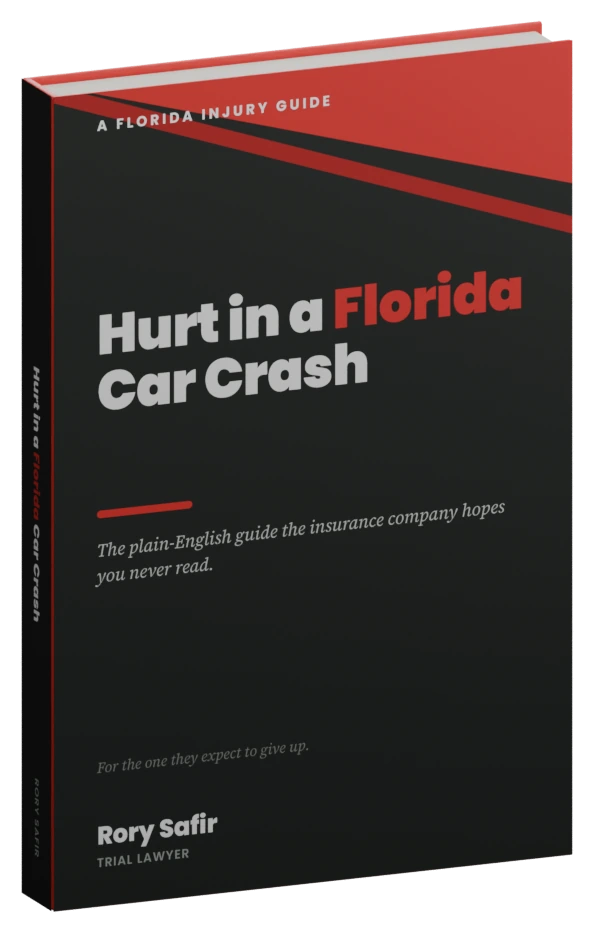
The book
Hurt in a Florida Car Crash
The insurance company’s playbook and Florida’s two-year deadline, in one plain-English book on the hours, days, and weeks after a crash. Free to Tampa Bay crash victims, with the digital edition to read the moment you ask.
Common Questions
Do I have a case after a motorcycle accident in Plant City?
If another driver’s negligence caused the crash and you were hurt, you likely do. Because motorcycles sit outside Florida’s no-fault system, you can pursue the full range of damages, pain and suffering included, without meeting the permanent-injury threshold that limits car cases.
Do motorcycle riders get PIP in Florida?
No. Florida’s no-fault law covers vehicles with four or more wheels, so a motorcycle is outside it and a rider collects no PIP benefits. Medical bills are paid by the at-fault driver’s liability coverage, your own uninsured motorist coverage if you have it, and your health insurance or medical payments coverage.
Can I still recover if I wasn’t wearing a helmet?
Often, yes. A rider over 21 may ride without a helmet if covered by a policy with at least $10,000 in medical benefits, under section 316.211. The insurer may argue a helmet would’ve reduced a head injury and try to cut your recovery through comparative fault.
How long do I have to file after a Plant City motorcycle crash?
Two years from the crash for most negligence claims, under section 95.11(5)(a). An early start protects the evidence, like the bike, your gear, video, and witness memories.
Will my Plant City motorcycle case be heard in Plant City?
Usually. Under the Thirteenth Judicial Circuit’s Administrative Order S-2024-079, a civil case is filed in the East Division, which sits in the Plant City Courthouse, when the cause of action accrued there or a defendant lives there. A judge can move a case to a Tampa division for good cause.
Is the first consultation free, and what does a motorcycle accident lawyer cost?
Yes, the first strategy session is free. These cases are handled on contingency, so you pay no attorney’s fees unless there’s a recovery, and case costs are advanced rather than paid up front. If there’s no recovery, you owe nothing, including case costs.