Pinellas County has one of the largest older populations in the country and a dense supply of assisted living facilities to match. Families choose an ALF for a loved one who needs help with daily living but not full-time skilled nursing, trusting the facility to supervise, to catch decline, and to keep residents safe. When one of them fails a resident, Florida law gives a strong remedy, built on rights that are written into statute and enforceable in court. If you suspect a Pinellas County assisted living facility has hurt someone you love, you have a civil claim, not just a complaint to file.
Assisted living is not a nursing home
A large older population, and facilities built for independence
Pinellas is a place many people choose for their later years, and assisted living facilities are a large part of how that works. Because an ALF is built for residents who are more independent, its failures look different from a nursing home’s, and understaffing is at the root of most of them. The one that turns deadly most often is elopement, a resident with dementia who wanders out an unsecured door and is hurt or lost, which is a supervision failure the facility is responsible for. The others follow the same thread, unwitnessed falls, medication given wrong or missed, a resident kept on past the point the facility could safely care for them, and the quiet neglect of hygiene, nutrition, and medical decline that no one caught. The trade a family makes in choosing assisted living over a nursing home is more independence for the resident in exchange for lighter supervision, and that trade only works when the facility staffs and secures the building to match the residents it accepts. The firm serves the whole county, with dedicated city pages for St. Petersburg, Clearwater, Largo, and Pinellas Park.
Assisted living residents have their own bill of rights
Florida writes ALF residents’ protections into statute. Every assisted living facility must honor a resident bill of rights, including the right to live in a safe and decent environment free from abuse and neglect, the right to dignity and privacy, the right to adequate and appropriate health care, and the right to raise grievances and reach an ombudsman without reprisal. Those rights are enforceable, because Florida law lets a resident or family bring a civil action for a violation or for negligence and recover actual and punitive damages. A proven violation of the bill of rights is evidence of negligence, and while it is not automatic proof, it is powerful, and the facility is held to the reasonable care a careful operator would use. Our residents’ rights page lists the protections in full.
Elopement, the pre-suit steps, and who really answers
Elopement and inadequate supervision are the signature assisted living failures, and a facility that admits or keeps a resident whose needs outrun its license and staffing has taken on a duty it cannot meet. An assisted living case is also not filed like an ordinary injury claim, because Florida requires a pre-suit notice and investigation first, gathering the records, having the care reviewed, and establishing a good-faith basis before the complaint, all against a deadline that makes starting early essential. And the responsibility reaches past the building to the licensee, the management company, and the corporate owners whose staffing and budget choices set the conditions for the harm. Our elopement and wandering and assisted living versus nursing home pages go deeper.
Where your case is heard, and what to do first
Pinellas County is part of Florida’s Sixth Judicial Circuit, and a lawsuit is generally filed in the Pinellas County civil court, whose main courthouse is in Clearwater, unless an enforceable arbitration agreement sends it elsewhere. Families are almost always the first to notice, so a few steps protect both the resident and any future claim. Watch for the signs, the unexplained falls, bruises, and injuries, the sudden weight loss or dehydration, the missed medication, the wandering or a door found propped, and the withdrawal or fear that can signal mistreatment. Document what you see with dated photographs and notes, request the resident’s records early since the facility controls them, and report suspected abuse to the Florida Abuse Hotline and the Agency for Health Care Administration. The Long-Term Care Ombudsman Program, reachable at 1-888-831-0404, is a free advocate for residents and families.
Assisted living is built on a promise of supervision and safety, and when a facility understaffs its way past that promise, I hold it and the corporation behind it to the rights Florida law guarantees. I read the records and the care documents the way I have my whole career, I move early to secure them and satisfy the pre-suit steps, and I represent residents and families, not the facilities or their insurers. I came up as a public defender trying cases and cross-examining witnesses, so I am ready to take one to a jury, and I handle your case personally throughout. These cases reach across Pinellas and the surrounding Gulf Coast counties, and the sooner a family calls, the more of the record we can protect before it hardens. Learn more about my background.
Common Questions
What is the difference between an assisted living facility and a nursing home?
An assisted living facility serves residents who need help with daily activities but not full-time skilled nursing, while a nursing home provides around-the-clock medical care. The distinction matters, because the facility’s license, the level of care it promised, and the right parties to hold responsible all depend on which kind it is.
My loved one wandered out and was hurt. Is the facility responsible?
Often yes. Elopement, when a resident with dementia leaves through an unsecured exit and is injured or lost, is usually a supervision and safety failure the facility is responsible for. Assisted living facilities have a duty to supervise residents in a way that matches their known needs.
Can we recover more than medical costs?
Often yes. Florida law allows a claim for a rights violation or negligence to recover actual and punitive damages, and where neglect causes a resident’s death, the family can bring a wrongful death claim. A mandatory pre-suit process applies and a deadline runs, so starting early matters.
What are the warning signs of ALF neglect?
Unexplained falls, bruises, and injuries, sudden weight loss or dehydration, missed medication, a resident found wandering or a door propped open, and a new fear or withdrawal around caregivers. Understaffing is behind most of it, and documenting what you see early protects the resident and any claim.
Where would my Pinellas County assisted living case be heard?
Pinellas County is in Florida’s Sixth Judicial Circuit, and a lawsuit is generally filed in the Pinellas County civil court, whose main courthouse is in Clearwater, unless an enforceable arbitration agreement sends it elsewhere. Preparing every case as if it will be tried protects its value.
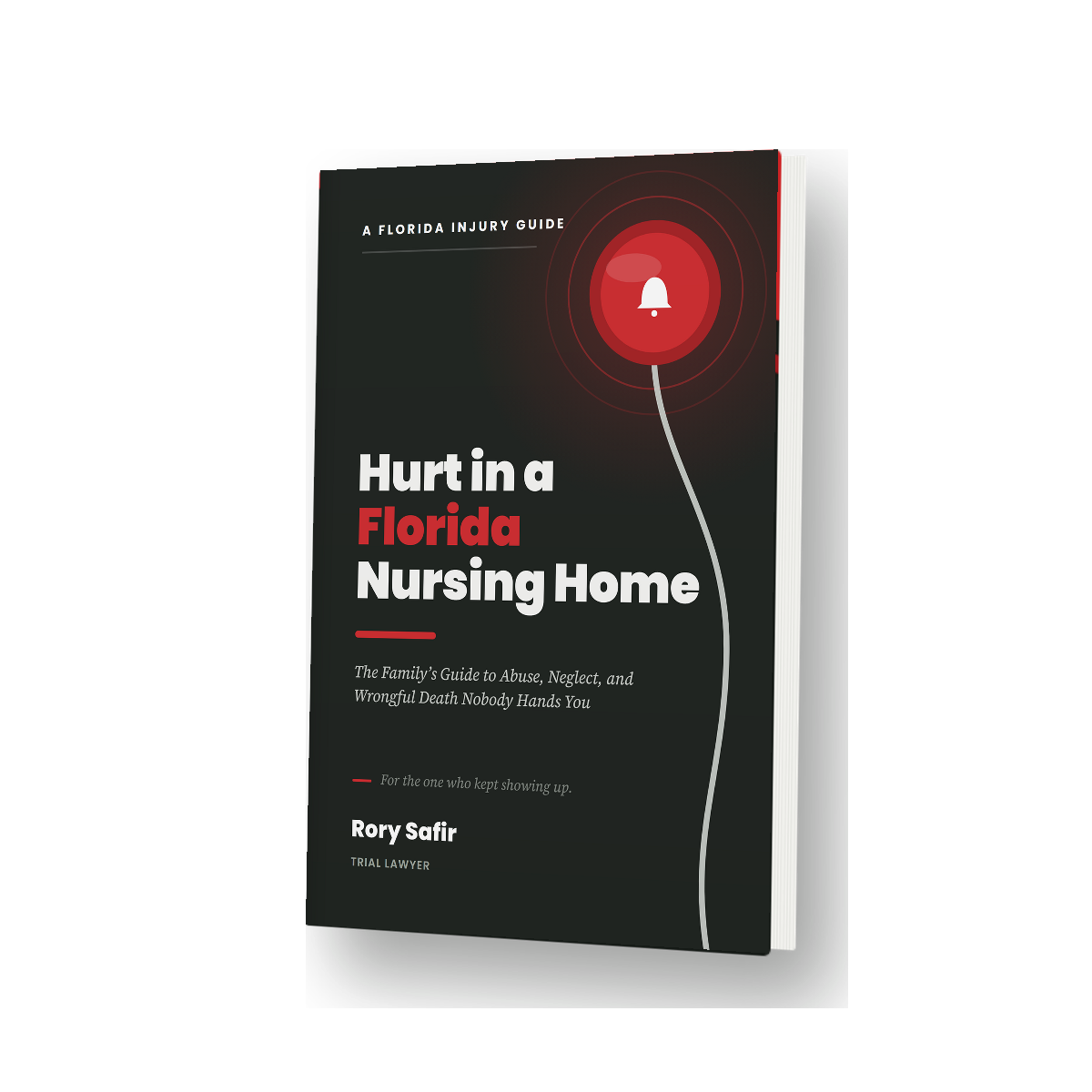
The book
Hurt in a Florida Nursing Home
The warning signs, the records race, the staffing spreadsheet at the root of almost everything, the arbitration trap, and the two-year clock that is shorter than it sounds, in one plain-English book written for the family that suspects something is wrong. Free to Florida families, with the digital edition to read the moment you ask.