
In Brief
No. No Florida statute requires you to perform the roadside exercises, and declining them carries no criminal charge and no license suspension. That sets them apart from the breath test, where refusal is now a crime. Declining is not consequence free, though: the officer can still arrest you on other observations, and prosecutors have argued at trial that a refusal shows you expected to fail.
Of all the roadside questions, this is the one where the popular understanding and the legal reality sit furthest apart. People assume the exercises work like the breath test, with a law behind them and a penalty for saying no. The two could not be built more differently.
On This Page
They Are Exercises, and the Word Matters
Florida courts call them field sobriety exercises rather than tests, and I use that word deliberately. A test implies a pass line, a validated scale, and a score you can dispute. What actually happens on the roadside is that an officer demonstrates a walking pattern or a balance position, watches you attempt it, and records the deviations. There is no passing score written anywhere on the form. The officer’s clues are the whole scoresheet, and I have cross-examined enough of them to tell you the counting gets presented as science without earning the word.
The battery’s own history says the quiet part. The three standardized exercises were developed in the 1970s under a federal contract, and they were built to predict whether a driver’s blood alcohol sat above a number, which is a different job from proving impairment. NHTSA’s own training materials say they are validated only when administered exactly the same way every time, by the book, step by step, and the same materials concede that footwear, age, weight, and physical condition matter, down to an instruction that a person in heels should be offered the chance to remove them. Now picture where yours happened: a road shoulder, in the dark, on sloped pavement, cars passing, in whatever shoes you wore out that night. The conditions that break the validation are the normal conditions of a traffic stop.
What Florida Law Actually Compels
Florida’s implied consent law, section 316.1932, is the statute that puts real force behind roadside testing, and it covers breath, urine, and blood. Read it and you will notice what is missing: the walk and turn, the one leg stand, and the eye test appear nowhere in it. There is no statute that compels the exercises, no license suspension for declining them, and no criminal charge for saying no.
The contrast with the breath test could not be sharper. Since October 1, 2025, refusing a lawful breath or urine test after a DUI arrest is itself a misdemeanor under section 316.1939, on top of the license suspension that was always there. I covered that change in what happens if you refuse the breath test. The exercises carry none of that machinery. That difference is not an accident, and it tells you how the legislature ranks the two kinds of evidence.
What Declining Changes, and What It Does Not
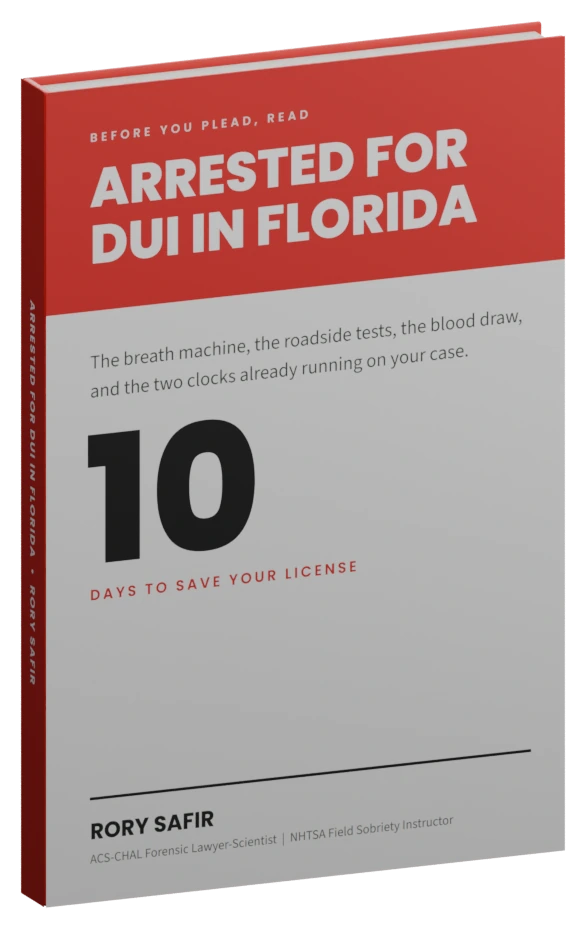
Officers rarely present the choice honestly. The line I hear on bodycam over and over is some version of, if you do not do these, I will have to make my decision based on what I have already seen. That is pressure, not law, and I wrote a whole chapter on it in my book. By the time the question is asked, the officer has usually decided.
Declining the exercises removes a category of evidence the State otherwise gets for free. It does not end the encounter. The officer still has the driving pattern, the conversation, the eyes, and the odor, and can still make an arrest on those observations alone. Many folks are surprised that the arrest usually follows anyway, because the officer had largely decided by the time the question was asked.
Declining also is not invisible at trial. Prosecutors have argued, with some success in Florida courtrooms, that refusing the exercises shows a driver expected to fail them. A jury hears that argument next to everything else, which is why the decision is a genuine trade rather than a free move. What the refusal cannot do is hand the State a video of you attempting a balance exercise at midnight, on a road shoulder, in headlights, with traffic passing, which is what the exercises produce and what the video usually shows more honestly than the report describes.
The Grading Started Before the Question
Here is the detail that changes how you should think about the whole sequence. The scoring does not begin when you start walking the line. Officers are trained to record clues from the moment of instruction: standing position during the explanation, starting early, asking to have instructions repeated. By the time the officer asks whether you will perform the exercises, the observation phase is already minutes old. The eye test has its own problems, including medical causes an officer cannot screen for, and I took one of those apart in the lazy eye post and on the site’s HGN science page.
Questions About the Roadside Exercises
Are field sobriety tests mandatory in Florida?
No. No Florida statute requires the roadside exercises, and declining them carries no license suspension and no criminal charge. Florida’s implied consent law covers breath, urine, and blood testing, and the roadside exercises appear nowhere in it.
Can refusing field sobriety exercises be used against me?
It can come up at trial. Prosecutors have argued that declining the exercises shows a driver expected to fail, and the arrest can still happen based on the officer’s other observations. Declining removes evidence but does not end the case.
Is the eye test part of implied consent in Florida?
No. The horizontal gaze nystagmus check is a roadside exercise, not a chemical test, so implied consent penalties do not attach to it. It also has documented medical confounds that have nothing to do with alcohol.
What This Means If You Are Charged
Whether you performed the exercises or declined them, the roadside record is built from an officer’s observations, and observations can be tested. The instruction phase, the surface, the footwear, the lighting, and the medical history all belong in that examination, and the video frequently disagrees with the report. That examination is the core of how I approach the stop and the field sobriety evidence in every DUI case I handle.
Further Reading
- Fla. Stat. 316.1932, implied consent, what it covers
- Fla. Stat. 316.1939, refusal to submit to testing, penalties
WRITTEN AND REVIEWED BY
Rory Safir, ACS-CHAL Forensic Lawyer-Scientist
He is the author of The Florida DUI Trial Manual, an NHTSA-qualified instructor in the standardized field sobriety exercises, faculty of the National College for DUI Defense, and a former Assistant Public Defender in the Thirteenth Judicial Circuit.
This post is general information about Florida law, not legal advice, and it does not create an attorney-client relationship. Implied consent testing is governed by section 316.1932, Florida Statutes, and refusal penalties by section 316.1939, neither of which reaches the roadside exercises. Whether and how a declined exercise may be used at trial depends on the facts and the state of the case law, which changes. Every case turns on its own facts, and past results do not guarantee a similar outcome.