
In Brief
Fourteen people were charged in a cocaine operation prosecutors say ran out of two Penn State fraternity houses, and the Florida version of the same case would be worse: trafficking starts at 28 grams here, a conspiracy statute punishes the agreement like the act, and FSU already produced the dorm-room version. Read the charge list from the bottom up.
On This Page
The Pennsylvania Attorney General charged fourteen people this month in a cocaine operation that prosecutors say ran out of two fraternity houses near Penn State through 2023 and 2024. The detail carrying the headlines is the initiation claim: according to the charging documents, some pledges were put to work cutting and packaging cocaine inside the houses as part of joining. One defendant’s father is charged too, accused of helping hide evidence after the investigation started.
Everything in that paragraph is an allegation. Nobody in the case has been convicted of anything, and the misdemeanor defendants in particular are exactly the people a case like this tends to sweep up first and sort out later. That sorting is what this post is about, because Florida has its own version of every charge on that list, and on one of them Florida law is harsher than most parents would guess.
Read the charge list from the bottom up
The fourteen defendants are not charged with one crime. The list is a ladder. At the top, two alleged ringleaders face trafficking counts. In the middle sit felony counts for corrupt organizations, conspiracy, and dealing in proceeds, the charges prosecutors use to treat a house as a business. At the bottom, eight student-aged defendants face misdemeanors for possession and paraphernalia.
The bottom of the ladder is where parents should look. Most of the people arrested in a house case are not charged for what they sold. They are charged for what was around them.
In Florida, the same case starts at 28 grams
Florida draws its trafficking line by weight, and the line is low. Under section 893.135(1)(b)1, Florida Statutes, 28 grams of cocaine, about an ounce, is trafficking: a first degree felony with a 3 year mandatory minimum and a $50,000 fine. From 200 grams the mandatory minimum is 7 years, and from 400 grams it is 15. A house-wide stash gets weighed as a stash, and weight does most of the work in these cases.
Then comes what reaches the pledges. Subsection (5) of the same statute:
Any person who agrees, conspires, combines, or confederates with another person to commit any act prohibited by subsection (1) commits a felony of the first degree and is punishable as if he or she had actually committed such prohibited act.
Agreeing to help package a trafficking quantity is punished like trafficking it. A nineteen year old who never sold a gram, but said yes to a night of cutting and bagging, has in Florida agreed his way into a mandatory minimum.
Florida already had this case. It was a dorm at FSU.
In 2018 the First District decided the case of a seventeen year old FSU student, identified as S.S., who lived in a four bedroom dorm townhouse. At 4:10 in the morning an officer responding to a noise complaint found marijuana and a mason jar in plain view on the common room table, five young men present, and S.S. standing at the back of the room by the stairs. His roommate testified that S.S. never used or possessed any of it, and that the roommate and his friends had been smoking all day. The group’s other memorable contribution to the record was an offer to play rock, paper, scissors to see who could take the charge.
S.S. was convicted anyway, and the appeals court affirmed. S.S. v. State, 242 So. 3d 532 (Fla. 1st DCA 2018). The rule that decided it comes from the Florida Supreme Court: possession does not require the drugs to be yours or on you. The State proves dominion and control plus knowledge, Knight v. State, 186 So. 3d 1005 (Fla. 2016), and where people jointly occupy a home, contraband "discovered in plain view in the presence of the owner or occupant is sufficient to support a conviction for constructive possession." Brown v. State, 428 So. 2d 250, 252 (Fla. 1983). One judge in the FSU case wrote separately just to say the quiet part: an "otherwise blameless dormmate," whose only transgression is being present when contraband sits in the common area, "can be swept into the same category as those actually using or possessing the illegal items."
The doctrine has a second edge, and it is where these cases get defended. When the drugs are NOT in plain view, joint occupancy is not enough. The State must bring independent proof tying the person to the contraband, fingerprints, an admission, incriminating circumstances, and "mere proximity to the contraband is not sufficient." Smith v. State, 175 So. 3d 900, 903 (Fla. 1st DCA 2015). A guest gets more protection still, because a guest is not presumed to control the house at all. Which of those rules applies, resident or guest, plain view or drawer, is frequently the entire case.
The hazing angle is real, but it cuts the other way too
Prosecutors describe the cocaine work as indoctrination for pledges, and Florida has a hazing statute waiting for that fact pattern. Section 1006.63 defines hazing as action that recklessly or intentionally endangers the mental or physical health or safety of a student for purposes of initiation or admission into an organization, and the statute is blunt about one thing: the pledge’s consent is not a defense. But the felony version requires serious bodily injury or death. A ritual that endangers nobody physically is, at most, misdemeanor territory, which is why the Penn State charges are drug charges rather than hazing charges.
For the defense, the same initiation framing runs the other direction. A pledge ordered to cut cocaine sits on the bottom rung of somebody else’s operation, doing what the organization built pressure to make him do. That is not a listed defense to conspiracy. It matters anyway, in charging decisions, in negotiations, and at sentencing, because every one of those turns on the difference between the person who built the machine and the person fed into it.
The saddest charge in the case belongs to a father
One of the fourteen defendants is a parent, accused of helping his son hide evidence once the investigation surfaced. Florida’s version is section 918.13, tampering with physical evidence, a third degree felony for altering, destroying, concealing, or removing anything with the purpose of impairing its availability in a proceeding.
Every criminal lawyer has seen the instinct. The phone gets wiped, the room gets cleaned, the backpack goes home with dad. It feels like protection and it manufactures a second case, one with cleaner proof than the first, because the cover-up usually leaves a better paper trail than the crime. The protective move is the boring one: touch nothing, say nothing, and put a lawyer between your kid and everyone else the same day.
If the call comes from a Florida campus
The firm keeps a short plain-language guide for exactly this phone call: your college student got arrested. The short version: nobody consents to a search of the room or the car, nobody gives a statement before counsel, the group chat goes silent about the case, and nobody plays rock, paper, scissors with a charge. The kid who stays quiet and calls a lawyer looks worse on the night and better every day after.
For lawyers
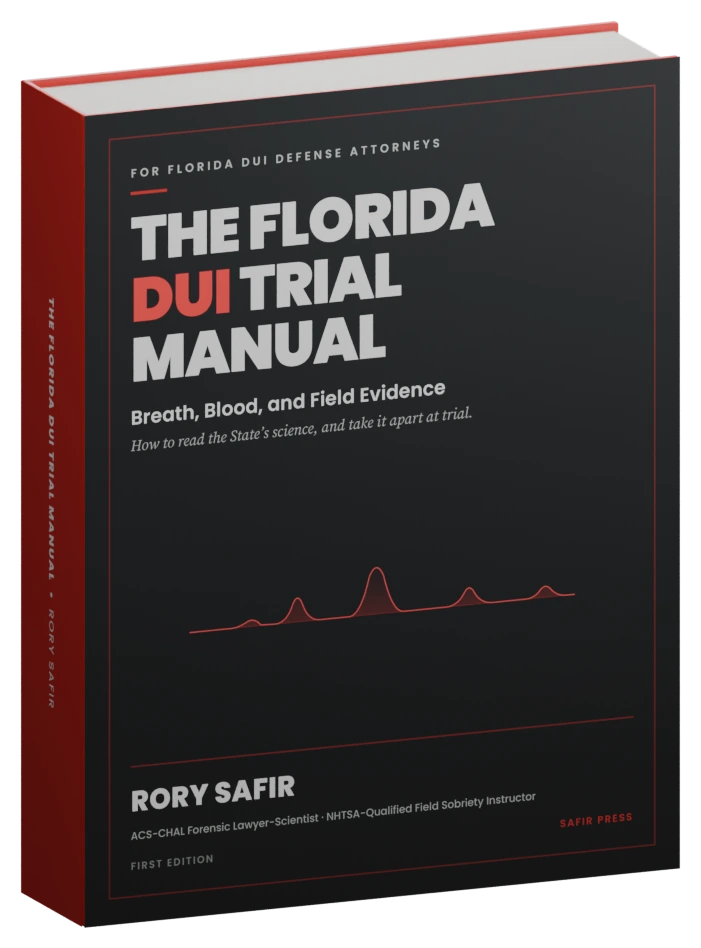
The joint occupancy cases above, with the verbatim holdings and the plain-view versus independent-proof split, are the skeleton of the motion in a shared-premises possession case. The method behind that kind of take-the-proof-apart defense, with the predicates and the cross examination sequences written out, is The Florida DUI Trial Manual.
Related reading: drug trafficking and mandatory minimums, possession of a controlled substance, drug conspiracy, and criminal defense in Florida.
WRITTEN AND REVIEWED BY
Rory Safir, ACS-CHAL Forensic Lawyer-Scientist
He is the author of The Florida DUI Trial Manual, an NHTSA-qualified instructor in the standardized field sobriety exercises, faculty of the National College for DUI Defense, and a former Assistant Public Defender in the Thirteenth Judicial Circuit.
This page is general information about Florida law, not legal advice, and it does not create an attorney-client relationship. It discusses a publicly reported out-of-state case in which every charge is an allegation and no defendant has been convicted. Every case turns on its own record, and past results do not guarantee a similar outcome.