At the roadside, an officer may ask you to hold a small swab in your mouth for a minute or two, feed it into a handheld analyzer, and wait a few minutes for a yes or no on drugs. That device gives a fast, simple answer to a simple question: is a trace of the drug present in your saliva right now? What it cannot answer is the question that decides a Florida DUI: how much, when, and whether you were impaired behind the wheel. A positive swab is a starting flag, not a finding of impairment, and the distance between those two things is where these cases are really fought.
The swab answers one narrow question, whether a drug is present. The questions that decide a Florida DUI, how much and when and whether you were impaired, sit outside what the device can measure.
What the Roadside Swab Is
The device an officer uses at the roadside is a portable, battery-powered oral fluid screener. A collection tip is held inside your mouth, wiped along the cheeks and tongue for roughly a minute or two, and then read by a small analyzer. Depending on the drug, a result comes back in about five to ten minutes, and the machine can store hundreds of results and download them to a computer later.
These roadside screeners test for a panel of common drugs, including amphetamines, methamphetamine, cocaine, opiates, cannabis, benzodiazepines, and methadone. Each drug has a set cut-off level. If the amount in your saliva sits above that line, the screen reads positive. That is the whole job of the device: to flag presence above a threshold, quickly, at the side of the road.
A Screen, Not Proof
This is the single most important thing to understand about the roadside swab. It is a screening test, sometimes called a presumptive or on-site test. It is not a confirmatory test, and it was never designed to be one. A positive roadside result is meant to be sent to a laboratory and confirmed on a second sample using far more sensitive equipment, and in many cases that confirmation is run on a blood sample rather than on saliva.
A positive roadside swab is the beginning of the inquiry, not the end of it. On its own it is a preliminary flag that a laboratory is then expected to confirm. Treating the screen as if it already proved drug impairment skips every step that is supposed to come after it.
Presence Is Not Impairment
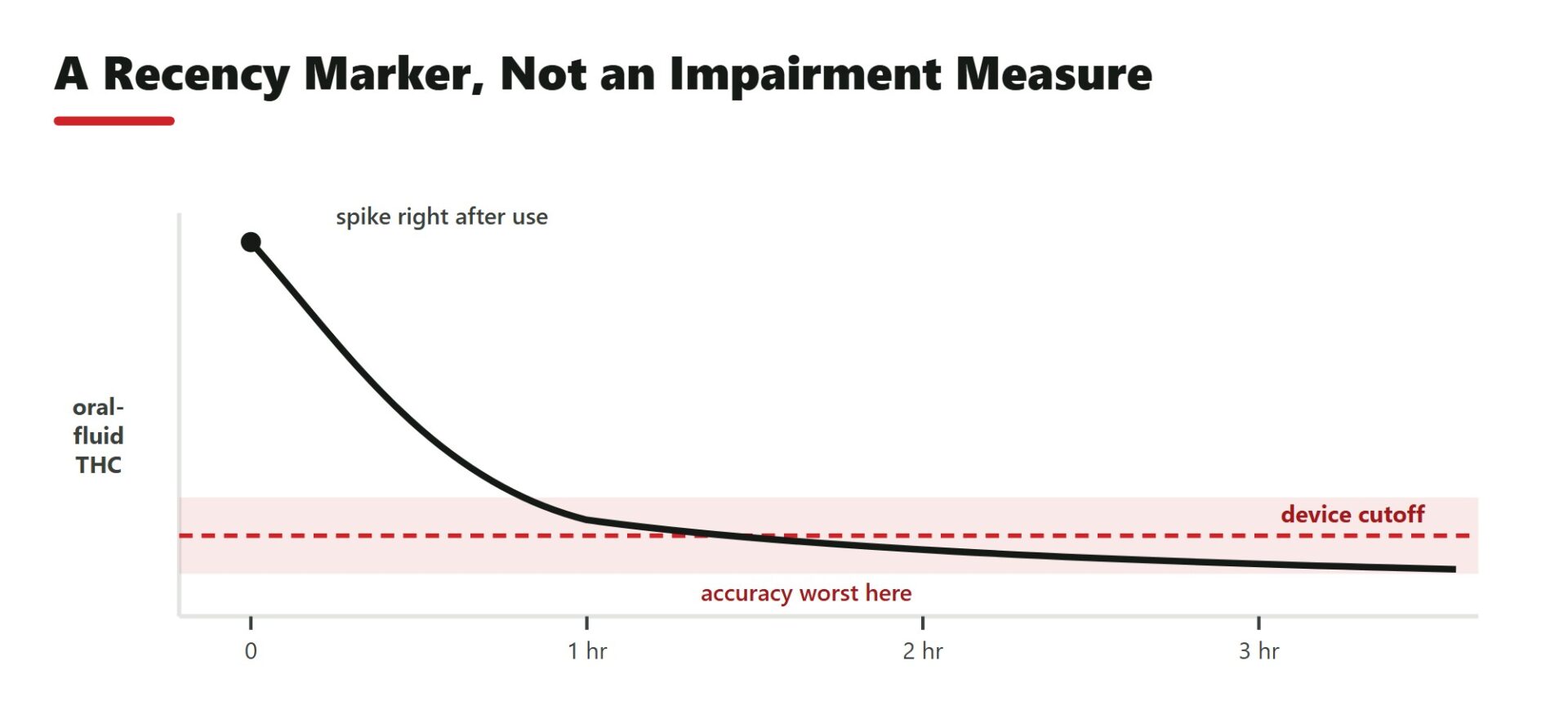
A positive swab tells you one thing: the device detected a trace of a drug substance in your saliva. It does not tell you how much of the drug is in your body, when you used it, or whether you were impaired while driving. A substance can still show up in saliva long after it has stopped producing any intoxicating effect, so a positive result can reflect use that happened hours earlier and has nothing to do with how you were driving.
Researchers who study these devices are direct about it. An expert panel report concluded that oral fluid tests cannot be used to give a precise prediction of the concentration of a drug in blood, and therefore cannot predict a drug’s likely effects. Even where the parent drug shows some loose relationship to performance, there is too much variation from one person to the next to read impairment off a roadside screen. Presence is a fact about your saliva. Impairment is a fact about your driving, and the two are not the same.
How Accurate Is the Swab
Field studies of on-site saliva screeners show a consistent pattern. These devices are good at ruling drugs out and much weaker at catching them when they are present. In one multi-site evaluation, specificity ran high, roughly in the ninety to ninety-nine percent range, meaning a clean result is usually a true clean result. Sensitivity was the problem. For cannabis, one study detected THC in only about one in five people who had used it, a rate that a state coordinator flatly called not acceptable given how often cannabis shows up in impaired driving arrests.
The devices also depend on the sample being collected correctly. Early field testing saw a large share of samples fail to give a valid reading at all, with control lines not appearing and result bands smearing. In device validation, a subject produced a false-negative simply by putting the tip in the mouth without letting it contact enough saliva. None of this means the screen is worthless. It means the screen is exactly that, a screen, and its results carry the error rates of a screen, not the certainty of a lab.
- High specificity, so a negative result is usually trustworthy.
- Lower and drug-dependent sensitivity, so a real drug can be missed, cannabis most of all.
- Collection matters, and a poor sample can produce an invalid or wrong reading.
- Accuracy differs drug by drug, so no single number describes the device.
- A high-CBD cannabis or hemp product with little or no intoxicating THC can still read positive for cannabis, so a legal or medical product can trip the screen.
Saliva Versus Blood
Saliva is easy to collect. It is non-invasive, the officer can watch the collection, and there is no needle. Those are real advantages for a roadside screen. But easy to collect is not the same as reliable for proving impairment, and that is where blood and saliva part ways.
Oral fluid reflects recent use, within hours rather than days, and for some drugs it carries much higher concentrations than blood because of how the substances behave in the mouth. Cannabis is a striking example: for roughly thirty to sixty minutes after smoking, THC in saliva can be many times higher than in blood because of contamination left on the oral tissues, then it drops off. Because of these differences, a roadside survey in Belgium found saliva flagged positive about 2.6 times as often as blood at matching cut-offs. That larger positive rate reflects saliva catching more presence, including presence that blood, the standard reference for drug levels in most cases, would not have flagged at all.
Where Florida Law Stands
Whether a roadside swab result comes into evidence, and how much weight it carries, depends on Florida law and on the specific facts of your stop. The one ruling people point to came out of California, where in 2016 a trial judge in People v. Salas, a vehicular-manslaughter case, held after a hearing that oral fluid results from one of these devices were reliable enough to go before the jury. It is worth being clear about what that ruling is and is not. It came from a single trial court, not an appeals court, so it would only carry weight across California if a higher court later upheld it, and an out-of-state trial ruling does not bind a Florida court at all. I am not aware of a Florida decision that has settled the question for this kind of device. This is a real, open area where the science and the admissibility rules both deserve close scrutiny in your case, and it is one of the first things I look at.
From the Trial Manual
Before you argue a single number, pin the State to the configuration. In writing, demand the device make, model, and software version, the exact cutoffs it was running, the calibration and quality-control records, the collection record, and any mass-spectrometry confirmation of the specimen. Then ask which validation study the State says describes that configuration, and what that study reported for it. An unconfirmed screen is a presumptive flag and nothing more, and a screen the State cannot tie to a validated configuration proves nothing about this driver.
That note is written for lawyers. It is from The Florida DUI Trial Manual, Ch. 10b, Oral Fluid Screening.
I started out as an Assistant Public Defender in Florida’s Thirteenth Judicial Circuit, in Tampa, and today I am one of six ACS-CHAL Forensic Lawyer-Scientists in Florida and a Faculty member of the National College for DUI Defense. That forensic training is exactly what a roadside drug swab calls for, because I can show a jury the difference between a screen that detected presence and a lab result that proves impairment. Learn more about my background.
Questions About the Roadside Drug Swab
What does a positive mouth swab prove?
It proves the device detected a trace of a drug in your saliva above a set cut-off, and nothing more. It does not show how much drug is in your body, when you used it, or whether you were impaired while driving. A drug can linger in saliva after any effect has worn off, so a positive swab can reflect earlier use that has no bearing on your driving.
Is the roadside swab a final drug test?
No. It is a screening test, sometimes called a presumptive or on-site test. A positive roadside result is meant to be sent to a laboratory for confirmation on a fresh sample, and in many cases that confirmation is run on blood rather than saliva. Treating the roadside screen as if it were already proof skips the confirmation step it was designed to trigger.
How accurate are these devices?
They tend to be good at ruling drugs out and weaker at catching them. Field studies show high specificity, so a negative is usually reliable, but lower sensitivity that varies by drug. For cannabis, one study caught THC in only about one in five users. A poor sample can also produce an invalid or wrong reading, so the accuracy depends heavily on how the swab was collected.
Why do saliva and blood give different answers?
Saliva reflects more recent use and can carry much higher drug concentrations than blood, cannabis especially, because of substance left on the tissues of the mouth. A roadside survey found saliva flagged positive about 2.6 times as often as blood at matching cut-offs. Blood remains the standard reference for drug levels in most cases, which is why a saliva screen and a blood result can point in different directions.
Can a roadside swab result be challenged in a Florida case?
Every case is different, but a roadside swab is a screen with known limits, and both its reliability and whether it is admissible under Florida law can be examined closely. I am not aware of a Florida appellate decision that has settled whether results from this kind of device come into evidence, which leaves real room to challenge them. I look at how the sample was collected, what the device can and cannot show, whether a proper laboratory confirmation was done, and whether the result connects to how you were driving. I do not predict outcomes, and past results do not guarantee a similar outcome.
Related pages: drug testing in a drug DUI, screening versus confirmation, presence is not impairment, and blood test defense.
Related: why a breathalyzer cannot detect THC.
This page is general information, not legal advice, and it does not create an attorney-client relationship. Drug DUI in Florida is governed by Fla. Stat. 316.193 and the controlled substances listed in chapter 893. Procedures and rules change, and every case turns on its own facts. Past results do not guarantee a similar outcome.