A Pinellas County assault, robbery or shooting on someone else’s property brings a criminal case against the person who did it, and that case stops there. Florida law can also hold the property owner responsible for failing to provide reasonable security against a crime it should have foreseen. The attacker may never be caught or may have nothing to pay; the owner had the duty, the power to fix the problem and insurance.
How a negligent security case works
Pinellas settings, and the pages for each city
These claims come from apartment complexes, hotels, bars, stores, parking lots and garages, anywhere a property owner controls the lights, the locks, the cameras or the guards. The setting matters early, because it decides which duty applies and whether the apartment presumption below is even available.
The firm serves all of Pinellas, with dedicated city pages for St. Petersburg, Clearwater, Largo, and Pinellas Park.
Was the crime foreseeable?
Florida courts have long held that a business owes its customers protection against criminal acts it can foresee, and that a residential owner has to keep common areas reasonably safe. Foreseeability is built from history: earlier robberies, assaults and shootings at the property or nearby that the owner knew about, or would have known about from police calls and its own incident reports. A documented pattern of violence next to thin security is where these cases are strongest.
If the Pinellas County Sheriff’s Office responded, it posts active calls, takes public records requests and offers victim services; a city police department keeps its own files. Our foreseeability and prior crime page explains how the pattern is proven.
Section 768.0706 and Pinellas apartment cases
Since 2023, section 768.0706 gives the owner of a property with five or more units a presumption against liability if it substantially implemented a list of measures. The list includes cameras at entry and exit points that keep footage at least 30 days, a parking lot lit to an average of at least 1.8 foot-candles, lighting in walkways and common areas, deadbolts, window locks, pool gates with key or fob access, and peepholes. The owner also needed a crime prevention assessment and staff training by January 1, 2025.
The owner carries the burden of proving all of that, and the presumption is rebuttable: proof that the measures were missing, broken or plainly inadequate to a known risk can overcome it. It covers residential buildings only, so hotels, bars, stores and parking operations have no presumption at all. Our apartment presumption page goes through the statute.
How fault gets divided
Two people share the blame here, the attacker and the owner who let the danger stand, and they’re worlds apart on paying. Since 2023, section 768.0701 tells the jury to weigh the fault of everyone who contributed, the attacker included, and section 768.81 reduces an award by any share put on you. A person more than 50 percent at fault for their own harm recovers nothing. That’s why I build these cases around the owner’s own choices: what it knew, what it spent and what it skipped. A guard company that didn’t do what its contract required can be a second defendant.
Courthouses and the evidence clock
Pinellas County is in the Sixth Judicial Circuit, where circuit civil handles disputes over $50,000. The main courthouse is the Pinellas County Courthouse in Clearwater, and the St. Petersburg Judicial Building also hears civil matters. A negligence claim is generally due within two years under section 95.11.
The evidence moves much faster. Get the police report number, photograph the lighting, broken locks or gates and any missing cameras, and let me send preservation letters for the video and incident reports. If the injury was fatal, Medical Examiner District 6 in Largo handles the death investigation. If you were treated at Orlando Health Bayfront Hospital, a Level II trauma center in St. Petersburg, I request the full chart. Our apartment assaults and parking lot and garage pages cover two common settings in more detail.
I came up as a public defender trying criminal cases, so I’m ready to take one of these to a jury. My job is to prove what the owner should have seen, and I represent the people hurt, never the properties or their insurers. I handle your case personally and prepare it for a jury. I take these cases across Pinellas and nearby counties. Learn more about my background.
Free guide No. 23
Attacked on Someone Else’s Property
The civil case nobody tells crime victims they have: foreseeability, the apartment presumption, the evidence race, and the deadlines, in plain English. Free, and one request unlocks the whole Safir Guides library.
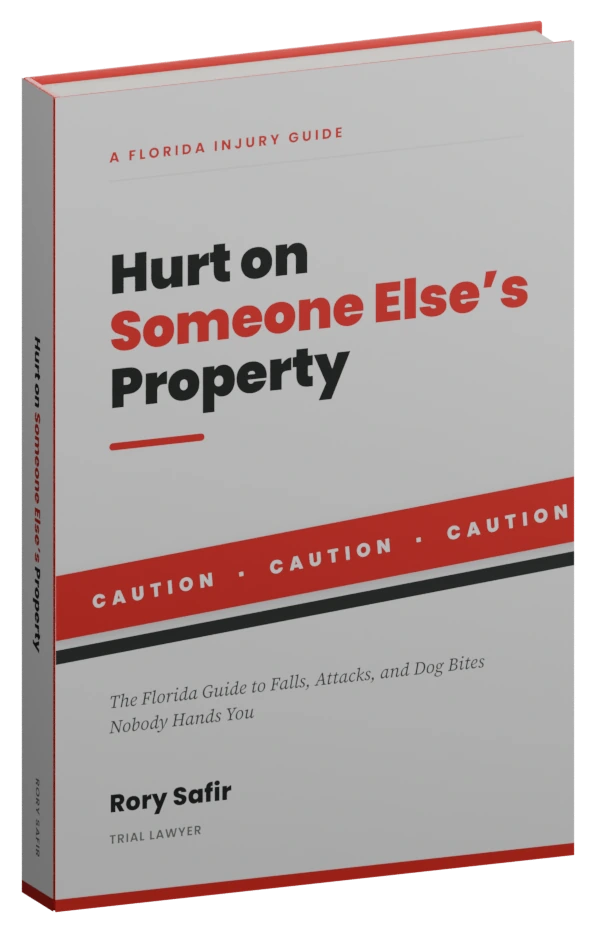
The book
Hurt on Someone Else’s Property
The evidence race, the notice fight, the owner’s records, and why many of these cases end up filed as lawsuits, in one plain-English book on the days and weeks after a fall. Free to Tampa Bay residents, with the digital edition to read the moment you ask.
Common Questions
The person who attacked me was never caught. Do I have a case?
Possibly yes. Negligent security cases are brought against the property owner, not the attacker. If the owner should have foreseen the crime from prior violence at or near the property and failed to provide reasonable security, the owner can be responsible even when the attacker is never identified.
The apartment complex says it had security, so is it protected?
Not automatically. Florida gives multifamily owners a rebuttable presumption against liability if they provided the security measures the statute lists, but it can be overcome by showing the measures were missing, broken, or inadequate, and it applies only to apartments, not hotels, bars, retail, or parking.
How do you prove the crime was foreseeable?
Through the history of the property and the surrounding area, the prior robberies, assaults, and shootings shown by police calls, incident reports, and crime data the owner knew or should have known about. A documented pattern of violence paired with thin security is what makes these cases strong.
Who pays if the property owner is liable?
Usually the property’s liability insurance. The attacker is often never caught or has nothing to pay a judgment, while the property owner carries coverage and had the duty and the ability to prevent a foreseeable crime.
Where would my Pinellas County negligent security case be heard?
Pinellas County is in Florida’s Sixth Judicial Circuit, and a lawsuit is generally filed in the Pinellas County civil court, whose main courthouse is in Clearwater. Most claims resolve through insurance first, but preparing every case as if it will be tried protects its value.