If you were assaulted, robbed, or shot on someone else’s property in St. Petersburg, the person who did it is not always the end of the story. Florida law requires a property owner to provide reasonable security against crime the owner should have foreseen, and when the owner does not, the injured person can hold the property responsible. These cases matter because the criminal is often never caught or has nothing to pay, while the property owner had both the duty and the insurance to answer for a preventable harm.
How a negligent security case works
Where St. Petersburg negligent security cases arise
These cases turn up where people gather and security gets cut. The downtown St. Petersburg nightlife district draws crowds and late hours. Apartment complexes across Pinellas, hotels along the beaches, and the parking garages and lots where people walk to their cars after dark are the settings I see most. What ties them together is a property that had reason to know about the risk and did too little about it, the dark lot, the broken gate, the guard who was promised and never there. Where the harm happened shapes which duty applies and whether the apartment presumption below is even available, so the setting is one of the first things to pin down. The pattern is almost always the same, a place that drew a crowd or sat in a rough area, a known history of trouble, and a security response that was cut to save money until someone was seriously hurt, and that gap between the known risk and the thin response is what a case is built to expose.
Foreseeability is the whole case
A negligent security case rises or falls on foreseeability, because a property owner’s duty to protect people from the criminal acts of a third party turns on whether that crime was foreseeable. Florida courts have long held that a business owes a duty to protect its patrons from foreseeable criminal acts, and that a residential owner has to keep common areas reasonably safe against them. Foreseeability is built from the history of the place and the area around it, the prior robberies, assaults, and shootings the owner knew about or should have known about from police calls and incident reports, so a property with a documented pattern of violence and thin security is where these cases are strongest. Proving the pattern is the work, and our foreseeability and prior crime page goes deeper.
The apartment presumption is a hurdle, not a wall
Florida gives apartment and other multifamily owners a specific defense worth understanding up front. An owner that provides the security measures the statute lists, things like lighting, locks, and cameras, earns a rebuttable presumption against liability for a third party’s criminal act. Two things keep that from ending a case. It is rebuttable, so proof that the measures were absent, broken, or plainly inadequate to the known risk can overcome it, and it applies only to multifamily residential, not to hotels, bars, retail stores, or parking operations, which have no such presumption. Reading whether the statute even applies, and whether the owner met it, is an early and decisive step, and our apartment presumption page breaks it down.
Two sources of recovery, and where your case is heard
There are usually two people at fault in these cases, the attacker and the property owner who let the danger stand, and they are worlds apart when it comes to recovery, because the attacker is often never caught while the owner carries insurance and had the power to prevent a foreseeable crime. That is why the case is built around the owner’s failure. St. Petersburg is in Pinellas County, part of Florida’s Sixth Judicial Circuit, so a lawsuit is generally filed in the Pinellas County civil court. The evidence that proves these cases disappears fast, so move quickly to preserve the property’s surveillance video and incident reports, get the police report number, and photograph the lighting, the broken locks or gates, and any missing cameras before they are fixed or gone. Our apartment assaults and parking lot and garage pages cover the settings we see most.
I spent years in the criminal courts, so I understand how these crimes happen and how the evidence around them is built, and I use that to prove what a property owner should have seen and failed to prevent. I move fast to lock down the video, the incident reports, and the prior-crime history before they are gone, I hold the owner to the duty the law imposes, and I represent the people harmed by preventable violence, not the properties or their insurers. I came up as a public defender trying cases, so I am ready to take one to a jury, and I handle your case personally throughout. Learn more about my background.
Common Questions
The person who attacked me was never caught. Do I have a case?
Possibly yes. Negligent security cases are usually brought against the property owner, not the attacker. If the owner should have foreseen the crime from prior violence at or near the property and failed to provide reasonable security, the owner can be held responsible even when the attacker is never identified.
The apartment complex says it had security, so is it protected?
Not automatically. Florida gives multifamily owners a rebuttable presumption against liability if they provided the security measures the statute lists, but it can be overcome by showing the measures were missing, broken, or inadequate to a known risk. And the presumption applies only to apartments, not hotels, bars, retail, or parking operations.
How do you prove the crime was foreseeable?
Through the history of the property and the surrounding area, the prior robberies, assaults, and shootings shown by police calls, incident reports, and crime data that the owner knew or should have known about. A documented pattern of violence paired with thin or broken security is what makes these cases strong.
Who pays if the property owner is liable?
Usually the property’s liability insurance. The attacker is often never caught or has nothing to pay a judgment with, while the property owner carries coverage and had the duty and the ability to prevent a foreseeable crime, which is why the case is built around the owner’s failure.
Where would my St. Petersburg negligent security case be heard?
St. Petersburg is in Pinellas County, part of Florida’s Sixth Judicial Circuit, so a lawsuit would generally be filed in the Pinellas County civil court. Most claims resolve through insurance before a lawsuit, but preparing every case as if it will be tried is what protects its value.
Also serving St. Petersburg for: car accidents, slip and fall, motorcycle accidents, truck accidents, and wrongful death.
Free guide No. 23
Attacked on Someone Else’s Property
The civil case nobody tells crime victims they have: foreseeability, the apartment presumption, the evidence race, and the deadlines, in plain English. Free, and one request unlocks the whole Safir Guides library.
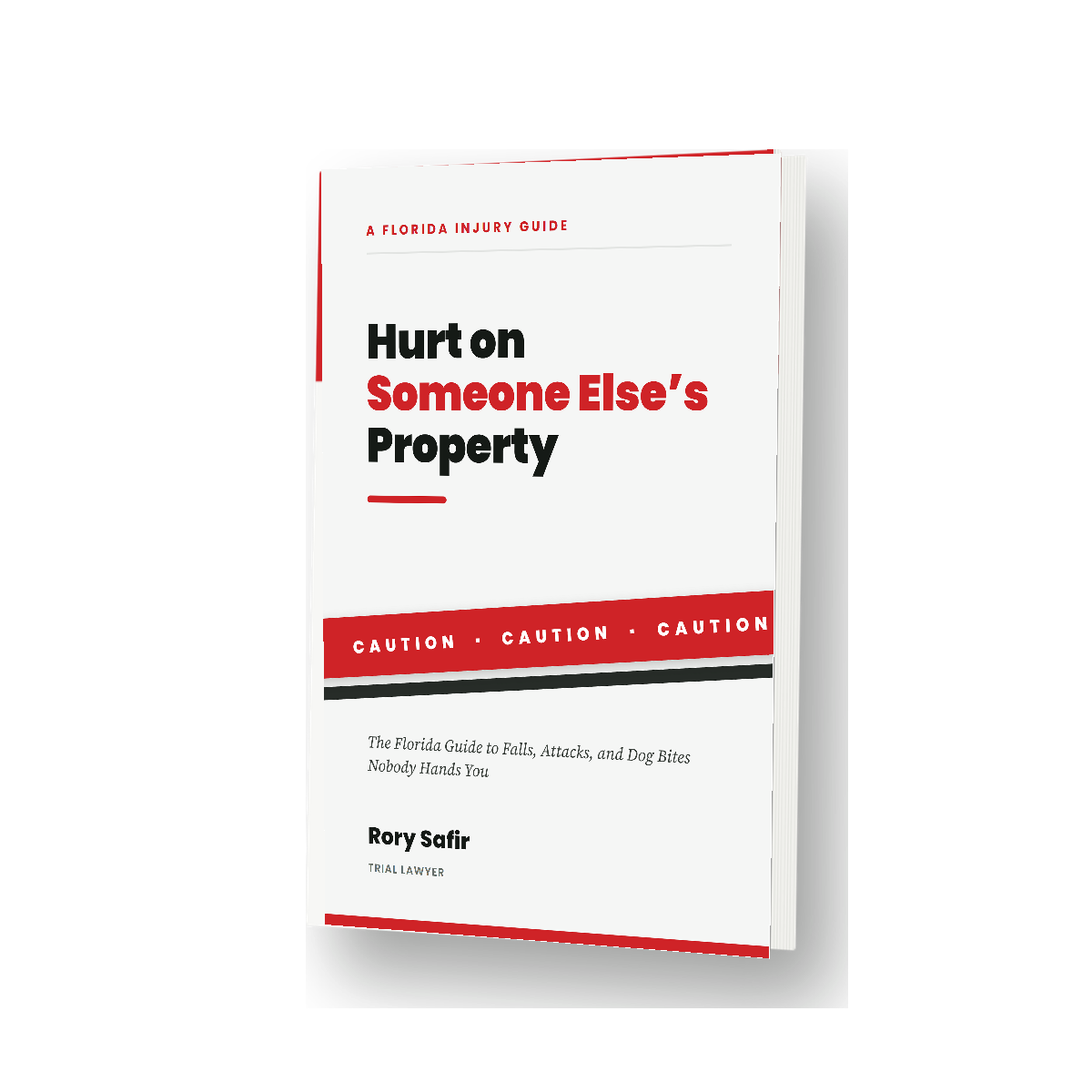
The book
Hurt on Someone Else’s Property
The evidence race, the notice fight, the owner’s records, and the honest truth that many of these cases have to be filed as lawsuits, in one plain-English book on the days and weeks after a fall. Free to Tampa Bay residents, with the digital edition to read the moment you ask.