
Clearwater families usually come to this office with a feeling before they come with proof: a parent who is suddenly thinner, a wound nobody mentioned, a fall that keeps happening. That feeling deserves to be checked against the facility’s own records. I represent Clearwater families in nursing home abuse, neglect, and wrongful death cases.
Clearwater’s facilities
Clearwater’s nursing homes serve a large coastal retiree population, clustered near Morton Plant and along the US 19 and Gulf-to-Bay corridors.
What to do this week
Start a dated notebook and photograph what you see. Request the complete chart in writing, because Florida law puts a working-day deadline on producing it. Report immediate danger to 911 and the state’s abuse hotline and the long-term-care ombudsman, which creates records the facility cannot edit, then have a lawyer send the preservation letter that freezes the video and staffing sheets. In these cases the family is the alarm system.
The clock, and the courthouse
A Clearwater case is litigated in the Sixth Judicial Circuit at the Pinellas County courthouse in Clearwater, after a presuit notice and investigation period, generally on a two-year discovery clock. I worked the defense side of these cases before I chose to represent families.
See also the Pinellas County nursing home abuse page.
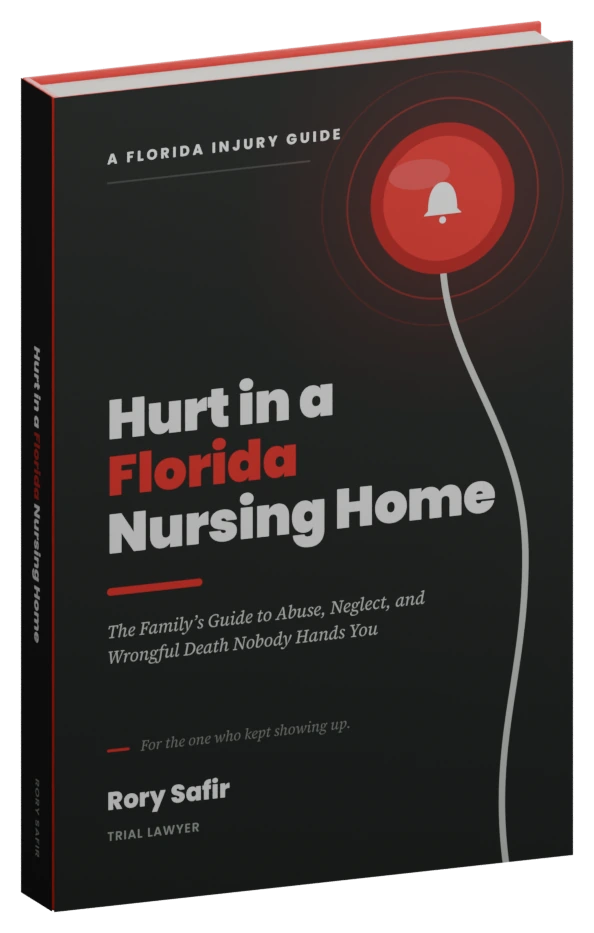
The book
Hurt in a Florida Nursing Home
The warning signs, the records race, the staffing spreadsheet at the root of almost everything, the arbitration trap, and the two-year clock that is shorter than it sounds, in one plain-English book written for the family that suspects something is wrong. Free to Florida families, with the digital edition to read the moment you ask.
Florida’s rules for a nursing home case
Florida law lists specific rights for nursing home residents, and a case is built on a violation of those rights or a failure to meet the standard of care. The time limit is two years from the incident, or from when it was discovered or should have been, and never more than four years from the incident. That outer limit stretches to six years only when fraudulent concealment or intentional misrepresentation kept the injury hidden.
Before a lawsuit can be filed, Florida requires a presuit notice sent by certified mail to each facility or person being claimed against, with a lawyer’s certificate that a reasonable investigation supports the claim. No suit can be filed for 75 days after that notice, the time limit pauses during those 75 days, and by the end of it the facility or its insurer has to reject the claim or make an offer. Mediation follows within 30 days of that response.
The records come first. A written request that meets federal privacy rules gets a current resident’s chart within 14 working days and a former resident’s within 30 working days, and the facility can charge no more than $1 a page for the first 25 pages and 25 cents a page after that. When a resident has died, the request comes from the estate’s personal representative, a representative named in a self-proved will, or, if there’s neither, the surviving spouse, then a child, then a parent, with the paperwork the statute requires.
Each of these problems has its own page:
- Assault and Sexual Abuse in a Nursing Home
- Bedsores and Pressure Injuries
- Falls in a Nursing Home
- Financial Exploitation of a Nursing Home Resident
- Florida Nursing Home Residents’ Rights
- Florida Nursing Home Staffing Requirements
- How Nursing Home Cases Are Proven
- How to Report Nursing Home Abuse and Check a Facility in Florida
- Malnutrition and Dehydration
- Medication Errors in a Nursing Home
- Nursing Home Infections & Sepsis
- Signs of Nursing Home Abuse and Neglect
- The Arbitration Agreement in Your Nursing Home Contract
- What Affects the Value of a Nursing Home Case
- Who Is Really Responsible for Nursing Home Neglect
- Wrongful Death in a Nursing Home
Common Questions
How do I get my mother’s records?
Put the request in writing as her health care surrogate, attorney-in-fact, or personal representative. Florida law gives the facility 14 working days to produce a current resident’s chart and 30 working days for a former resident, so keep a copy of the dated request.
Is every bad outcome a case?
No. Frail people fall in good facilities, and skin can fail at the end of life despite real care. What separates tragedy from a case is the pattern: the staffing, the records, and a story that does not add up.
What does it cost?
Contingency: no fee unless there is a recovery, and the strategy session is free. The greater cost is usually waiting, because the records race runs whether or not anyone is running it.
Related reading: nursing home abuse, bedsores, and about Rory Safir.