Pinellas County is home to one of the largest older populations in the country, and St. Petersburg has a dense supply of nursing homes to match, many of them rated below average on staffing and health inspections. Families make the hard decision to place a loved one in that care trusting the facility to protect them, and when abuse or neglect happens instead, Florida law responds with more than a regulatory complaint. If you suspect a St. Petersburg nursing home has harmed someone in your family, the law gives you a civil claim built on a resident’s enforceable rights.
How a Florida nursing home claim works
A large older population, and facilities under strain
Pinellas is a place many people choose to spend their later years, and the number of nursing homes here reflects that. Size is not the problem, understaffing is, and short staffing is at the root of most of the harm I see, the pressure sores that form when no one turns a resident, the falls that follow when no one answers a call light, the missed medications, and the quiet decline that no one catches. When a facility takes a family’s trust and a monthly check and then cuts the care below what safety requires, Florida law does not treat that as a private disappointment. It treats it as an enforceable wrong, and the reports families can make to the Florida Abuse Hotline and the state’s Agency for Health Care Administration run alongside, but do not replace, a civil claim. The warning signs a family learns to watch for, the pressure sores, the weight loss, the falls, and the sudden change in mood or condition, are often the first evidence that the staffing was never enough, and they are worth documenting from the moment they appear, because the facility controls the official chart and a family’s own dated record can matter a great deal later.
Florida gives nursing home residents a bill of rights
Florida does not leave a resident’s protection to goodwill. Every licensed nursing home must honor a statement of residents’ rights, including the right to be free from abuse, neglect, and improper physical or chemical restraint and the right to adequate and appropriate health care. Those rights have teeth, because Florida law creates a civil cause of action for negligence or a violation of resident rights and allows recovery of actual and punitive damages. A proven violation of the bill of rights is evidence of negligence, and while it is not automatic proof, it carries real weight, and the facility is held to the reasonable care a careful licensee would use. Our residents’ rights and how these cases are proven pages go further.
The pre-suit steps, the arbitration clause, and who really answers
A nursing home case is not filed the way an ordinary injury claim is, because Florida requires a mandatory pre-suit investigation first, gathering the records, having a qualified professional confirm the standard of care was breached, and establishing a good-faith basis, all against a two-year deadline that makes starting early essential. Two things surprise families most. The first is the arbitration agreement folded into the admission paperwork, which can push a claim out of court, yet these can often be declined at admission or challenged later. The second is who answers, because liability reaches past the building to the licensee, the management company, and the corporate owners whose staffing and budget choices set the conditions for the harm. Our arbitration agreements and who is responsible pages break both down.
Where your case is heard, and what to do first
St. Petersburg is in Pinellas County, part of Florida’s Sixth Judicial Circuit, so a lawsuit is generally filed in the Pinellas County civil court unless an enforceable arbitration agreement sends it elsewhere. Families are usually the first line, so a few steps protect both the resident and any future claim. Watch for the markers of neglect, the bedsores, the sudden weight loss and dehydration, the unexplained falls, fractures, and bruises, and the withdrawal or fear that can signal mistreatment. Document what you see with dated photographs and notes, keep a record of who you spoke to and when, and request the resident’s records early, since the facility controls them. Report suspected abuse to the Florida Abuse Hotline and the Agency for Health Care Administration, and be cautious with anything the facility asks you to sign after an incident.
Families trust these facilities with the people they love most, and when that trust is broken, I hold the facility and the corporation behind it to the rights Florida law guarantees. I read the medical records and the care documents the way I have my whole career, I move early to secure them and satisfy the pre-suit steps, and I represent residents and families, not the facilities or their insurers. I came up as a public defender trying cases and cross-examining witnesses, so I am ready to take one to a jury, and I handle your case personally throughout. Learn more about my background.
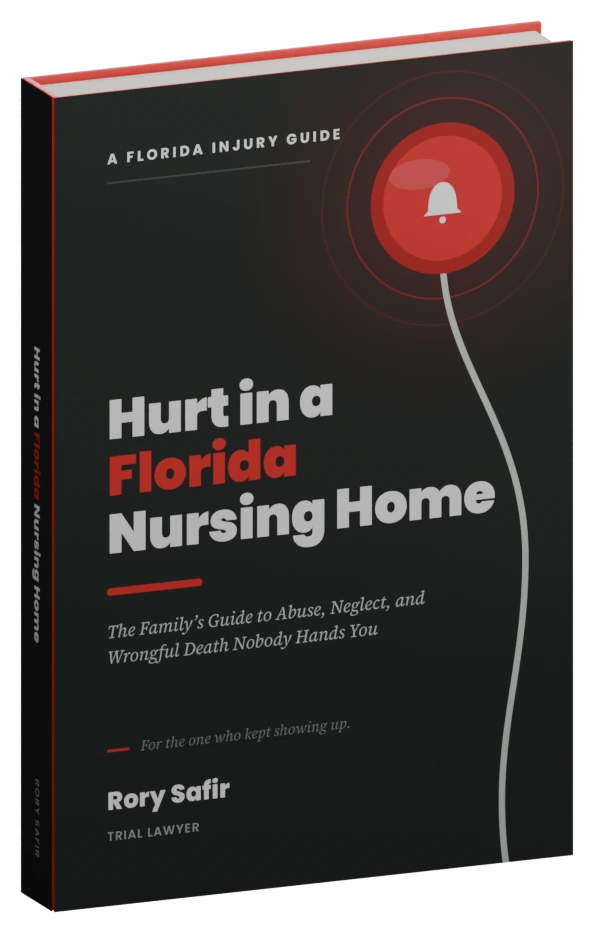
The book
Hurt in a Florida Nursing Home
The warning signs, the records race, the staffing spreadsheet at the root of almost everything, the arbitration trap, and the two-year clock that is shorter than it sounds, in one plain-English book written for the family that suspects something is wrong. Free to Florida families, with the digital edition to read the moment you ask.
Common Questions
We signed an arbitration agreement at admission. Are we stuck?
Not necessarily. Facilities routinely include arbitration agreements in admission paperwork, and signing one can affect where a claim is heard, but these agreements can often be declined at admission and can sometimes be challenged later depending on how and when they were signed. It is worth having yours reviewed rather than assuming it forecloses a court case.
Who can be held responsible besides the facility?
Often more than the facility itself. Florida law allows claims against the licensee, the management company, and the corporate owners whose staffing and budget decisions led to the harm. That matters, because the accountability and the insurance coverage frequently sit at the corporate level rather than the individual building.
How long do we have to bring a nursing home claim?
A two-year deadline generally applies, and a mandatory pre-suit investigation has to be completed before the case can be filed. Because that pre-suit work takes time, starting early is what preserves the claim rather than losing it to the deadline.
Is reporting to the state the same as a lawsuit?
No. A complaint to the Agency for Health Care Administration triggers a regulatory investigation that can lead to fines or corrective orders, while a civil lawsuit seeks compensation for the resident’s injuries. The two are separate, and pursuing one does not prevent the other.
Where would my St. Petersburg nursing home case be heard?
St. Petersburg is in Pinellas County, part of Florida’s Sixth Judicial Circuit, so a lawsuit would generally be filed in the Pinellas County civil court, unless an enforceable arbitration agreement sends it elsewhere. Preparing every case as if it will be tried is what protects its value.
Also serving St. Petersburg for: car accidents, slip and fall, motorcycle accidents, truck accidents, and wrongful death.