Dogs are everywhere in St. Petersburg, on the Central Avenue patios, at the Saturday market and in the Grand Central District, and most of the time that’s part of what makes the city good to live in. When one of those dogs bites someone, Florida law already answers the question people expect to fight about: the owner is responsible, even for a first bite. What’s left is how badly you were hurt, who was at fault for what, and which insurance policy pays.
Florida's dog bite rule
Where dogs and people meet in this city
St. Petersburg is one of the most dog-friendly cities in Florida. Dogs fill the breweries along Central Avenue, pack the dog parks, turn out for the festivals, and have their own off-leash spots like The Dog Bar and Mutts and Martinis in the Grand Central District. Every one of those places is a public place or a place you’re lawfully allowed to be, and that’s exactly where Florida’s dog bite statute reaches. A bite at a park, on a sidewalk, at a friend’s house or outside a shop is judged by the same rule.
Pinellas County also bars dogs from running loose. Section 14-63 of the county code makes a dog at large a violation regardless of what the owner knew or meant, so if the dog that bit you had slipped its leash or its yard, that ordinance belongs in the record too.
What the owner can’t argue
The owner can’t say the dog never did this before. Under section 767.04, an owner is liable for a bite to someone in a public place, or lawfully in a private place including the owner’s own property, regardless of the dog’s former viciousness or the owner’s knowledge of it. You don’t have to prove the owner was careless.
Injuries without a bite are covered too. Section 767.01 makes an owner liable for other damage the dog does to a person, such as knocking someone down, though that claim requires proof of who owns the dog.
What the insurer will argue instead
With liability that strong, the owner’s insurer goes to the exceptions. A “Bad Dog” sign that was prominently displayed and easy to read can protect an owner, but never when the person bitten is a child under 6, and never when the owner’s own negligence, such as an open gate, caused the bite. The insurer may also say you provoked the dog or were trespassing. Florida’s comparative-fault rule reduces recovery by your share of fault, and the statute protects only people who were lawfully present. The facts usually answer those arguments, and my dog bite defenses page goes through each one.
The policy behind the dog
The money almost always comes from a homeowner’s or renter’s liability policy. Reading that policy matters, because some carriers write in breed exclusions or low limits that change what’s available. When a landlord knew a tenant’s dog was dangerous and could have done something, the landlord’s coverage may be a second source.
Children need special attention. The Centers for Disease Control reports that young children have the highest rate of emergency room visits for dog bites, their injuries tend to be to the face and head, and the sign defense is gone entirely for any child under 6. My homeowners insurance and children and dog bites pages go further on both.
Reporting the bite in St. Petersburg
Report it. Pinellas County Animal Services handles dangerous-dog enforcement, and it works with the Florida Department of Health in Pinellas County to check every bite for rabies risk. If the dog may be dangerous, section 767.12 has the animal control authority investigate and decide whether to classify it, with a hearing for the owner. That report is often the first official account of the dog, the owner and the address.
Then get medical care right away, because bites carry a real infection risk and the medical record ties the injury to the attack. Get the owner’s homeowner’s insurance information and the dog’s vaccination records, photograph the injuries as they heal and the place it happened, including whether a “Bad Dog” sign was posted, and be careful on any call with the owner’s insurer, which is usually looking for a provocation or trespass angle.
If it has to be filed
Most dog bite claims resolve with the homeowner’s insurer. When one doesn’t, St. Petersburg is in Pinellas County, part of Florida’s Sixth Judicial Circuit, and a lawsuit is generally filed in the Pinellas County civil court. The St. Petersburg Judicial Building on 1st Avenue North hears circuit and county matters, including civil cases.
My work is to prove the full weight of the harm and to answer the sign, the provocation claim and the trespass argument before they take hold. I represent the people who were bitten, not owners or their insurers, and I came up as a public defender trying cases, so I’m ready to take one to a jury when that’s what full value requires. I handle your case personally from the first conversation through resolution. Learn more about my background.
The book
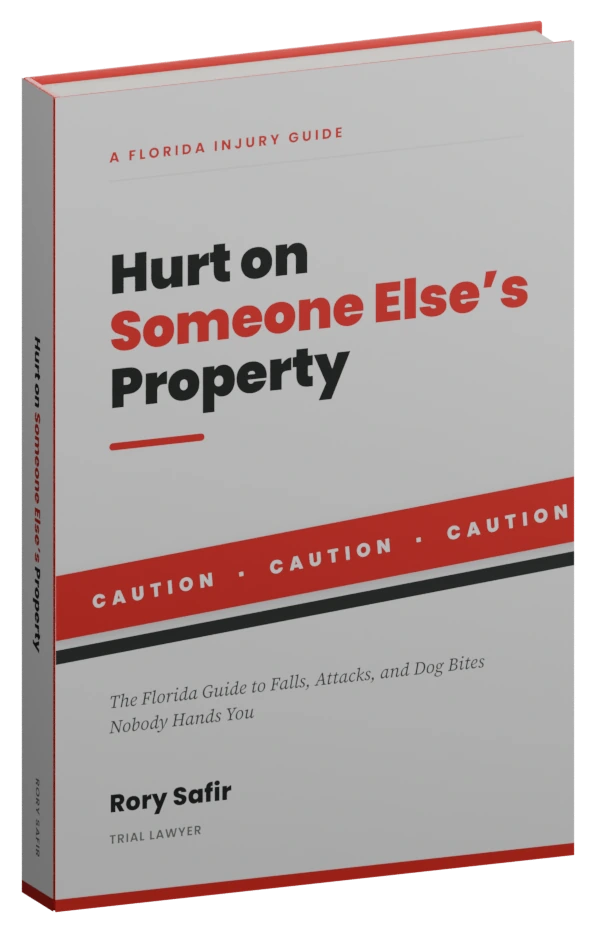
Hurt on Someone Else’s Property
The evidence race, the notice fight, the owner’s records, and why many of these cases end up filed as lawsuits, in one plain-English book on the days and weeks after a fall. Free to Tampa Bay residents, with the digital edition to read the moment you ask.
Common Questions
The dog had never bitten anyone before. Does the owner still owe me?
Yes. Florida is not a one-free-bite state. Under the dog bite statute, an owner is liable for a bite in a public place or while you are lawfully on private property regardless of the dog’s past behavior or the owner’s knowledge of it. The dog’s clean history does not relieve the owner of responsibility.
There was a “Bad Dog” sign. Am I out of luck?
Not necessarily. A prominently posted, easily readable “Bad Dog” sign can be a defense, but it has two exceptions. It does not apply if the bitten person is a child under 6, and it does not apply if the owner’s own negligence, such as letting the dog loose, caused the bite. Whether the sign protects the owner depends on the facts.
Who pays a dog bite claim?
Usually the owner’s homeowner’s or renter’s liability insurance. Some policies contain breed exclusions or low limits, so identifying the right policy and its terms early matters. Where a landlord knew a tenant’s dog was dangerous, there may be an additional source of recovery.
What if I was partly at fault for the bite?
Florida uses comparative fault, so provoking the dog or ignoring a clear warning can reduce recovery by your share, and past a certain point it can bar it. Those arguments are answerable with the facts, and they are a common insurer tactic rather than the end of a claim.
Where would my St. Petersburg dog bite case be heard?
St. Petersburg is in Pinellas County, part of Florida’s Sixth Judicial Circuit, so a lawsuit would generally be filed in the Pinellas County civil court. Most claims resolve with the homeowner’s insurer before a lawsuit, but preparing every case as if it will be tried is what protects its value.
Also serving St. Petersburg for: car accidents, slip and fall, motorcycle accidents, truck accidents, and wrongful death.