In Brief
A DUI blood number arrives in court sounding final. The number depends on how the tube was drawn, stored, refrigerated, and tested, and every one of those steps can fail in ways the paperwork records. This post previews three of those failure points from the firm’s free guide to the DUI blood test, and the whole guide goes deeper.
It isn’t. It’s the beginning of the question. That’s the whole point of my newest Safir Guide, The DUI Blood Test. Blood is my signature territory. I’m one of only six ACS-CHAL Forensic Lawyer-Scientists in Florida, and I spent 160 hours at Axion Analytical Labs in Chicago learning the same methods the State’s experts use. Before that, I was an Assistant Public Defender in the Thirteenth Judicial Circuit in Tampa, where hundreds of cases taught me that official-looking paper is not the same thing as proof.
Three things from the guide
1. Hospital blood and legal blood are not the same evidence
Legal blood is whole blood, drawn under Florida’s implied consent law or a warrant, and it comes with a statutory presumption that helps the prosecution. Hospital blood is different. It’s drawn to treat you, not to convict you, and it’s usually serum or plasma rather than whole blood. Here’s the chemistry that matters: serum reads higher than whole blood. Florida’s 0.08 limit contemplates whole blood, so a hospital number has to be converted, and that conversion produces a range of possible values, not one clean figure. The guide walks through why that gap gives the defense real room to work.
2. A badly stored sample can brew its own alcohol
This is the one my clients find hardest to believe. If a blood sample isn’t properly preserved and refrigerated, microorganisms inside the tube can turn blood sugar into alcohol. The sample ferments, and the number the lab measures days later can be higher than what was in your body at the draw. Delay makes it worse. Heat makes it worse. The good news is that fermentation leaves chemical footprints an expert can look for. The guide explains what those are and who has to demand the data that makes looking possible.
3. The license clock doesn’t wait for the lab
A qualifying blood result at or above 0.08 can trigger an administrative license suspension separate from the criminal case. You have 10 days to demand a formal review hearing with the DHSMV, and because blood results come back late, that window generally runs from when the result is reported. While the hearing is pending, you get a 42-day temporary permit. Miss the window and you’ve given something up before your case even starts.
Listen
A recent Florida decision is this post in a single case. A driver said no to a blood draw, police had it taken anyway without a warrant, and an appeals court threw the result out and took back the sentence prosecutors had been using to justify draws like it. A blood result is a claim, and that is what happens when somebody makes the State prove it. The case is covered in the caselaw edition of Reasonably Safir, along with the Pinellas timeline case behind it.
What sits behind the number
Since this post first went up, the blood pages on the site have grown a section on the record trail, and it’s the part I’d read first if there’s blood in your case. A result sheet says one number. The file behind it says what was measured (whole blood or serum, in what units), when it was drawn and when it was tested, how the tube was collected and stored, and how the instrument produced the result, down to the calibration and the controls. None of those records proves the number is wrong by itself, and I don’t claim they do. What they show is what was and wasn’t checked, and a lab that can’t reconstruct its own run has a problem a jury can understand. The full list is on the record trail behind the number.
Get the whole guide
The guide covers much more: the swab, the tube, the mixing, the chain of custody, and the discovery list I send in every blood case. It’s free, and one email unlocks the entire Safir Guides library at thesafirlawyer.com/free-guides. If you’d rather read on the web, the complete blood test section has the full coverage.
And if there’s blood in your case right now, skip the reading and get in touch. Every case is different, and the earliest days are when the records are easiest to chase down.
You’re better Safir than sorry.
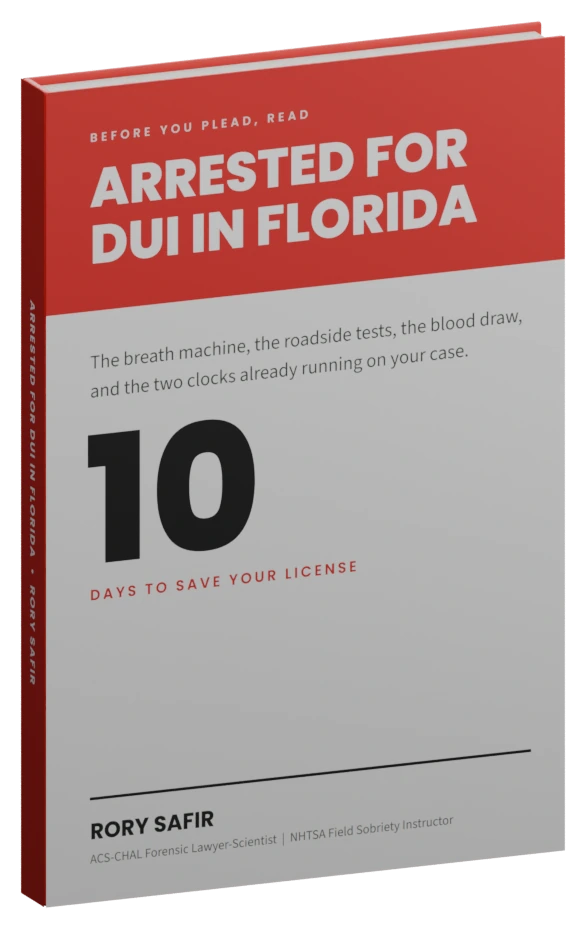
The book
Arrested for DUI in Florida
What a forensic lawyer-scientist wants you to know before you plead: the ten day license clock, the breath machine, the roadside exercises, and the three roads out of a DUI. Free to Tampa Bay residents facing a charge, with the digital edition to read the moment you ask.

About the author
Rory Safir is a St. Petersburg attorney who handles injury claims and criminal defense across the Tampa Bay area. He is one of a handful of ACS-CHAL Forensic Lawyer-Scientists in Florida and a former Assistant Public Defender in Tampa, and he brings that same evidence-driven approach to fighting for injured clients.
WRITTEN AND REVIEWED BY
Rory Safir, ACS-CHAL Forensic Lawyer-Scientist
He is the author of The Florida DUI Trial Manual, an NHTSA-qualified instructor in the standardized field sobriety exercises, faculty of the National College for DUI Defense, and a former Assistant Public Defender in the Thirteenth Judicial Circuit.
This post is general information about how DUI blood testing works and how it is challenged. It is not legal advice about any specific case.